Benefits of Rope Access for High-Rise Building Maintenance in Los Angeles
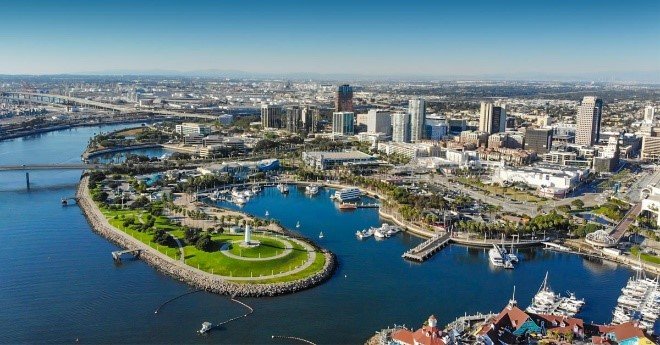
Skyworks Unlimited · Los Angeles, Long Beach & Southern California High rise building maintenanceFrom the glass towers of Downtown Los Angeles to the hilltop commercial buildings of Signal Hill, the coastal high-rises of Long Beach to the luxury residential towers of Beverly Hills — certified rope access has become the professional standard for high-rise building maintenance across Southern California for one straightforward reason: it is safer, faster, more cost-effective, and less disruptive to building tenants and street-level operations than every traditional access alternative. This complete guide covers every benefit of certified rope access over scaffolding, boom lifts, and suspended work platforms — for window cleaning, exterior caulking, facade inspection, hard water treatment, and every other at-height maintenance task your building requires — with real context from the markets Skyworks Unlimited serves across Los Angeles and Southern California.
60% maximum cost reduction vs. scaffolding on equivalent high-rise access projects in Los Angeles Days rope access mobilization timeline vs. weeks for scaffolding permits in LA, Beverly Hills & Long Beach Lowest incident rate of any at-height access method — per IRATA industry safety data 8+ building maintenance task types completed in a single rope access mobilization visit 🔗Understand the credential first: Every benefit of certified rope access depends on the crew being genuinely certified — not just experienced. Before reading this guide, understand what SPRAT and IRATA certification actually requires and why it matters for your building. Read Why SPRAT & IRATA Certification Matters for Your High-Rise Window Cleaning.
01 What Certified Rope Access Actually Is — and Why the Certification Matters
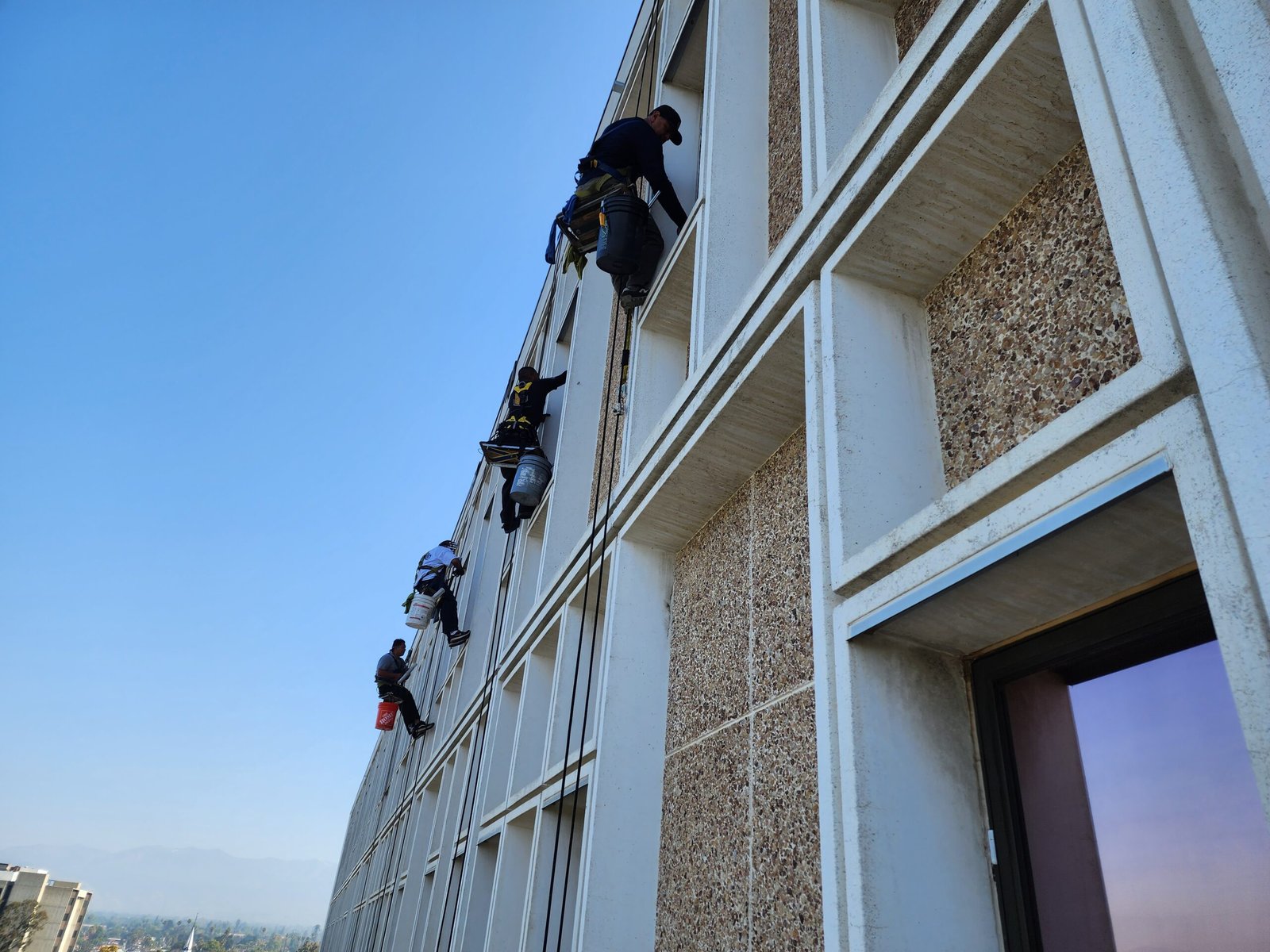
Rope access is a method of at-height work in which a technician is suspended on a system of ropes to reach elevated surfaces on a building — performing window cleaning, caulking, facade inspection, or any other maintenance task that would otherwise require scaffolding, a boom lift, or a building maintenance unit (BMU). In its uncertified form, rope access is simply a person with a rope and descent equipment. In its certified form — to SPRAT (Society of Professional Rope Access Technicians) or IRATA (Industrial Rope Access Trade Association) standard — it is a documented, inspected, supervisor-controlled system with individual credential requirements at every level, mandatory written hazard assessments, specific anchor verification protocols, and an independently audited incident record that is lower than every other at-height access method in industrial use.
The distinction matters because the benefits described throughout this guide — the cost savings, the safety record, the mobilization speed, the insurance profile — all apply specifically to certified rope access. An uncertified operator with ropes does not carry those benefits. They carry the risk profile of an unsupervised at-height system, and they transfer that risk to the property owner whose building they are working on when an incident occurs and their policy does not cover it. For property managers across Santa Monica, Pasadena, Hollywood, and every other market Skyworks Unlimited serves, certification verification is the single most important hiring step before any high-rise maintenance contract is signed.
Every benefit in this guide is a benefit of certified rope access. The first step to accessing those benefits is confirming that the contractor you are evaluating is genuinely certified — not marketing certified. Read our complete checklist in Questions to Ask Before Hiring a Window Cleaning Service to know exactly what to verify and what answers mean a contractor is qualified.
⚠️ The most important distinction in the Los Angeles rope access market: “Rope access” is not a protected term. Any contractor can call their work rope access regardless of certification status. In Los Angeles, Long Beach, Beverly Hills, Signal Hill, West Hollywood, and every other Southern California market Skyworks Unlimited serves, the difference between a certified and uncertified rope access operator is invisible on a website — and extremely visible when an incident occurs and the insurance claim is denied. Always ask for individual SPRAT or IRATA certificates before signing.02 Benefit 01 — Dramatically Lower Cost Than Scaffolding or Boom Lifts
Cost is the most immediately measurable benefit of certified rope access for high-rise building maintenance in Los Angeles and Southern California — and the cost advantage is larger than most property managers initially expect when they see the first rope access quote alongside a scaffolding bid.
Cost Saving ANo Scaffold Erection or Dismantling Labor
A rope access crew rigs from the roof in two to four hours and begins productive work the same morning. There is no separate scaffold crew to hire, no multi-day erection period during which the building is disrupted without any maintenance being performed, and no dismantling cost at project close. On a 20-story commercial tower in Downtown Los Angeles, Long Beach, or Pasadena, scaffold erection and dismantling labor alone can represent tens of thousands of dollars before a single window has been cleaned or a single bead of caulk applied.
Cost Saving BZero Permit Fees for Sidewalks, Streets, or Lane Closures
In dense Los Angeles urban markets — Beverly Hills, Santa Monica, West Hollywood, Hollywood, and Downtown LA — scaffold projects require permits from the Los Angeles Department of Building and Safety and, frequently, sidewalk encroachment permits and temporary lane closure approvals from the Los Angeles Department of Transportation. These permits take weeks to process and carry fees that are not trivial on high-traffic commercial corridors. Rope access requires no sidewalk or lane permits. A managed ground exclusion zone below the work area is the full public safety footprint — no permit applications, no processing timelines, no fees.
Cost Saving CShorter Project Duration Means Lower Total Labor Cost
Rope access mobilizes in days rather than weeks. For a property manager in Culver City, Torrance, or Bixby Knolls dealing with a deferred maintenance item or a pre-lease window cleaning requirement, the ability to schedule and complete a project within a short window — rather than waiting three to six weeks for scaffold permits and equipment availability — has direct financial value in avoided liability exposure and lease-readiness delays. Shorter duration also means fewer working days of labor cost on the overall project, since the access system is not adding fixed days that do not produce maintenance output.
Cost Saving DOne Mobilization Covers Multiple Maintenance Tasks
A certified rope access crew physically adjacent to the building facade can perform window cleaning, exterior caulking inspection and spot repair, hard water stain assessment, sealant application, facade photography, and signage work in the same mobilization visit — because every task is accessible from the rope. This multi-task efficiency is particularly valuable for buildings in Signal Hill, Lakewood, Seal Beach, and Los Alamitos where the annual maintenance budget benefits from consolidating visit counts. Scaffolding projects require separate mobilizations for tasks in different phases or elevations — rope access collapses those into one.
🔗See the full cost breakdown: The cost savings above are quantified with real Los Angeles market comparisons in our dedicated cost guide. Read How Rope Access Saves Money on Building Maintenance in Los Angeles for the complete analysis — including a side-by-side comparison of rope access, scaffolding, boom lifts, and BMU costs across Southern California building types.
03 Benefit 02 — The Lowest Incident Rate of Any At-Height Access Method
Safety is not just a moral and legal requirement for high-rise building maintenance — it is a financial one. An incident on your building generates insurance claims, Cal/OSHA investigations, project suspensions, potential civil liability, and reputational consequences for the property that no maintenance budget plans for. Certified rope access has a statistically lower incident rate than scaffolding, boom lifts, and suspended work platforms — and that safety record is not accidental.
Safety Factor 01Two-Rope Redundancy — No Single Point of Failure
Every certified rope access descent requires an independent working line and a completely separate safety line, rigged to separate anchor points and cross-checked by a second crew member before anyone descends. This two-rope system means a single failure — whether of a component, a connection, or an anchor — cannot cause an uncontrolled fall. Scaffolding has no equivalent redundancy: a structural failure in a scaffold component, a missed connection during erection, or an inadequate anchor can compromise the entire platform. For high-rise building maintenance in Long Beach, Beverly Hills, or Downtown Los Angeles, the two-rope system is the core technical reason certified rope access produces the safety record it does.
Safety Factor 02Mandatory Written Hazard Assessment Before Every Session
SPRAT and IRATA standards both require a written, site-specific hazard assessment completed on the morning of every project — covering wind speed, overhead hazards, anchor point condition, electrical proximity, pedestrian exclusion zone plan, and emergency egress routes. This assessment cannot be reused from a prior visit. In wind-exposed markets like Signal Hill, Santa Monica, and Sunset Beach — where coastal and hilltop conditions can trigger suspension criteria on otherwise clear days — the day-of hazard assessment is the mechanism that prevents work from proceeding in conditions that are unsafe regardless of schedule pressure. No other access method mandates an equivalent daily written evaluation at the field level.
Safety Factor 03Level 3 Supervisor Present for the Full Duration
Certified rope access requires a Level 3 Supervisor — the highest field certification level — to be physically present on-site for the full duration of every project. This is not a remote supervision standard or a periodic check-in requirement. The Level 3 Supervisor is the person who verifies anchor loads, conducts the hazard assessment, cross-checks the rigging before descent, manages the ground exclusion zone protocol, and has authority to suspend operations if conditions change. For property managers in Pasadena, Culver City, and Venice who are not always present on-site during maintenance sessions, this supervision requirement is the assurance that the certified standard is being maintained throughout the project — not just at setup.
Safety Factor 04Anchor Point Inspection and Load Verification Before Every Descent
Every anchor point used for a rope access session must be physically inspected and verified against manufacturer load ratings before any rope is attached. In Los Angeles markets with significant older building stock — Signal Hill‘s mid-century commercial towers, Pasadena‘s historic commercial buildings, and Downtown LA’s pre-modern mixed-use structures — this step is critical. Anchor infrastructure on buildings that have not been maintained or upgraded may fail load requirements. A certified contractor documents and reports anchor failures to the building owner rather than proceeding with unverified rigging. This is the standard that uncertified operators most commonly skip — and the omission that most often generates incidents on older Los Angeles buildings.
04 Benefit 03 — Minimal Tenant Disruption Across All Building Types
For commercial property managers and building owners in competitive Los Angeles leasing markets, tenant experience during maintenance is not a soft consideration — it is a lease renewal factor. Scaffolding on a Class-A office building in Beverly Hills, a residential tower in West Hollywood, or a professional office complex in Pasadena disrupts tenant experience in multiple compounding ways. Certified rope access eliminates every one of those disruption categories.
Disruption Eliminated 01No Scaffold Structure Blocking Windows or Natural Light
A multi-story scaffold on a commercial building in Hollywood, Culver City, or Santa Monica blocks natural light for every tenant floor it covers — sometimes for weeks or months on a phased project. Rope access leaves no permanent structure on the building exterior between working sessions. Technicians descend, complete their work, and ascend — leaving the facade clear between sessions and every floor’s window view unobstructed when work is not actively in progress on that elevation.
Disruption Eliminated 02No Multi-Week Erection and Dismantling Periods
Scaffold erection and dismantling on a high-rise commercial property in Long Beach or Torrance generates noise, vehicle traffic, equipment deliveries, and crew presence that extends well beyond the actual maintenance window. The erection period — during which no productive maintenance is occurring — can equal or exceed the actual project duration. Rope access has no erection period. The crew arrives, rigs from the roof in hours, and works. On a two-day window cleaning project for a Signal Hill commercial tower, the productive work period and the total project duration are effectively the same.
Disruption Eliminated 03No Scaffold Footprint in Lobbies, Parking, or Common Areas
Scaffolding on street-adjacent buildings in dense Southern California markets frequently requires equipment staging in lobbies, parking structures, or common areas. In Bixby Knolls, Lakewood, and Los Alamitos commercial properties where parking is already constrained, scaffold vehicle presence and material staging can generate genuine operational disruption for tenants and building management. Rope access requires roof access, a freight elevator, and a managed ground exclusion zone directly below the work area — nothing else. No lobby staging. No parking displacement.
Disruption Eliminated 04Flexible Scheduling Around Tenant Business Hours
Rope access work can be scheduled to begin before business hours, complete highest-visibility or noisiest sections early in the day, and integrate around tenant schedules in ways that scaffold projects — with fixed equipment in place and phased work zones — cannot. For residential high-rises in Seal Beach, Rossmoor, and Sunset Beach where HOA boards manage maintenance around resident preferences, this scheduling flexibility is a practical benefit that scaffolding simply cannot offer.
05 Benefit 04 — Full Facade Access with No Architectural Limitation
Scaffolding and boom lifts are constrained by the geometry of the building they are serving. Scaffolding cannot reach setback elevations, recessed balconies, or cantilevered architectural features without custom engineering. Boom lifts are limited by outreach radius, ground clearance requirements, and the availability of level ground surface to operate from — which rules them out for many mid- and high-rise buildings in Hollywood Hills, hillside Pasadena properties, and the upper elevations of Signal Hill. Certified rope access has no equivalent geometric constraint. A technician on a rope can access any point on a building’s exterior that the rope can reach from a verified anchor above — including recessed panels, step-back floors, balcony undersides, and complex curtain-wall mullion systems that no ground-based access method can reach.
For buildings in Venice with irregular facade articulation, commercial towers in West Hollywood with curved glass features, and residential complexes in Culver City with recessed balconies that collect soiling faster than the main facade, rope access is frequently the only access method that can reach every maintenance-required surface without custom equipment engineering. This geometric universality means the certified rope access quote is the only quote that actually covers the full scope of the job as the building was designed — not the job as a scaffold or boom lift can reach it.
🔗Related reading: Drone-assisted facade surveys complement rope access by documenting elevations and recessed features that are difficult to assess even from the rope. Read How Drone Technology Improves Exterior Building Cleaning to see how aerial surveys and certified rope access work together for complete facade coverage on complex Southern California buildings.
06 Benefit 05 — Early Defect Detection That Prevents Major Repair Costs
A certified rope access crew performing window cleaning or facade maintenance is physically adjacent to every square foot of the building envelope — in a way that no ground-based inspection, no drone survey, and no window cleaning from inside can replicate. At arm’s length from the glass, the caulk, the sealant, the metal frames, and the cladding panels, a professional technician routinely identifies maintenance issues that would remain invisible to any other inspection method until they have advanced to the costly stage.
Detection 01Caulk and Seal Failure Before Water Intrusion Begins
Cracking caulk, adhesion-loss at the window perimeter, and early sealant degradation are visible at arm’s length during a rope access cleaning session but invisible from the ground, from inside the building, and from a drone at inspection distance. Catching a caulk joint at Stage 1 or Stage 2 degradation — before water has entered the wall assembly — costs a fraction of what Stage 3 and 4 remediation costs once the insulation, sheathing, and framing are involved. For buildings in Seal Beach, Sunset Beach, and coastal Long Beach where UV and salt air accelerate caulk degradation, this early detection function has direct and measurable financial value at every quarterly maintenance visit. Read our full window caulking guide for Los Angeles properties to understand the full cost framework for caulk failure stages and replacement timelines.
Detection 02Hard Water Staining Before Glass Etching Occurs
Stage 1 mineral deposits on glass — freshly formed calcium and salt residue that has not yet chemically bonded to the silica surface — can be identified and treated during a routine rope access cleaning visit at standard cleaning cost. Left unidentified for another maintenance cycle, the same deposits reach Stage 2 (bonded, requiring professional acid treatment) or Stage 3 (etched into the glass surface, requiring cerium oxide polishing). For coastal buildings in Long Beach, Signal Hill, Seal Beach, and Venice where coastal air accelerates mineral staining, early detection at every cleaning visit is the cost management strategy. Read our full guide on hard water window stains in coastal Southern California for the complete staging and treatment framework.
Detection 03Glass Seal Failures, Frame Corrosion & Cladding Issues
Failed insulated glass unit seals — identifiable by interior fogging between panes — frame corrosion on metal surrounds, loose cladding panels, and cracked spandrel covers are all conditions that a rope access technician observes at close range during routine cleaning work. These issues, if identified early and documented in the project’s inspection report, give property managers in Torrance, Lakewood, Rossmoor, and Los Alamitos the opportunity to plan capital repairs in an annual maintenance budget rather than respond to emergency conditions. The photo-documented inspection report that Skyworks Unlimited delivers at every project close is the mechanism that captures and communicates these findings reliably.
07 Benefit 06 — Every Maintenance Task in a Single Mobilization
One of the most practically valuable benefits of certified rope access for Southern California building maintenance is the breadth of tasks a single certified crew can perform in a single visit to a building — eliminating the need for separate mobilizations for each maintenance category and compressing annual maintenance costs significantly.
🪟 High-Rise Window Cleaning Complete exterior glass cleaning on all elevations — every floor, every pane, including specialty coated and low-E glass. 🧱 Exterior Caulking & Sealant Window perimeter caulk removal, substrate prep, and professional silicone re-application at any height. 🔍 Facade Condition Inspection Close-proximity glass, caulk, frame, cladding, and sealant inspection — photo-documented at every level. 💧 Hard Water & Mineral Treatment Professional acid treatment and cerium oxide polishing for Stage 2 and Stage 3 mineral deposits on coastal-exposed glass. 🚿 Pressure Washing & Surface Cleaning Spandrel panel cleaning, bird waste removal, and exterior surface washing at any building elevation. 💡 High-Level Lighting & Fixtures Exterior lighting fixture access, lamp replacement, and fitting inspection above boom lift operational range. 📐 Signage Installation & Removal Building signage access, attachment point installation, and panel removal at heights impractical for other access methods. 📷 Drone-Paired Facade Survey Aerial photography paired with rope access inspection for complete building envelope documentation and defect mapping.08 Benefit 07 — A Lower Insurance Risk Profile for Your Building
The financial benefits of certified rope access extend beyond the project invoice. For property owners and managers across Beverly Hills, Santa Monica, Pasadena, and Downtown Los Angeles, the choice of maintenance contractor affects the building’s risk exposure in ways that accumulate over time and eventually reach the insurance relationship.
A property that maintains its high-rise building exterior with documented certified rope access visits — each producing a written hazard assessment, a photo-documented inspection report, and a certified crew manifest — is building a maintenance history that demonstrates due diligence to insurers, to prospective tenants conducting building due diligence, and to capital partners reviewing a property’s asset management record. A property that uses uncertified or uninsured at-height contractors generates no equivalent documentation — and generates liability exposure whenever an incident occurs that the contractor’s policy does not cover.
Certified rope access is not just the right maintenance choice for a Southern California high-rise — it is the choice that produces a defensible, documented maintenance record. That record has value in every context where the building’s condition and maintenance history are evaluated: insurance renewals, lease negotiations, property sales, and institutional reporting across every market from Long Beach to Hollywood to Signal Hill.
09 Certified Rope Access vs. Every Alternative — Full Comparison
Here is how certified rope access compares to scaffolding, boom lifts, and building maintenance units (BMUs) across every dimension that matters for high-rise building maintenance in Los Angeles and Southern California:
| Dimension | Certified Rope Access | Scaffolding | Boom Lift | BMU / Cradle |
|---|---|---|---|---|
| Total Project Cost | Lowest — no erection, permit, or dismantling costs | 40–60% higher — erection, permits, dismantling all added | 20–40% higher — equipment hire & outreach limits add cost | High fixed cost — only viable if BMU already installed |
| Mobilization Speed | Days — roof rigging complete in hours | 3–6 weeks — permits, procurement, erection | 1–3 days — ground setup required | Variable — depends on building equipment condition |
| Permit Requirements in LA | Minimal — roof access & ground exclusion zone only | LADBS permit, sidewalk encroachment, lane closure possible | Street access permit on dense corridors (Beverly Hills, Santa Monica, Hollywood) | Minimal if BMU installed and current |
| Safety Incident Rate | Lowest — two-rope redundancy, Level 3 Supervisor, day-of hazard assessment | Higher — structural assembly variables, extended site presence | Moderate — tip-over risk, outreach limitations | Moderate — depends on BMU maintenance history |
| Architectural Access | Full — any elevation reachable from a verified anchor above | Limited — cannot reach setbacks, recessed sections, or overhangs without custom engineering | Limited — max ~10 stories; ground clearance and level surface required | Track-limited — only reaches surfaces on the BMU track path |
| Tenant Disruption | Minimal — no permanent structure, no light blockage, flexible scheduling | High — weeks of view obstruction, light reduction, erection noise | Moderate — vehicle presence, noise, parking displacement | Low if BMU is operational and quiet |
| Multi-Task Efficiency | Excellent — cleaning, caulking, inspection, repair in one mobilization | Moderate — tasks must be sequenced within scaffold zone | Limited — task range restricted by platform type and outreach | Limited — BMU typically designed for a single task type |
| Inspection Documentation | Full photo-documented report at project close — standard deliverable | Depends on contractor — not standard practice | Depends on contractor — not standard practice | Depends on operator — not standard practice |
10 Certified Rope Access Building Maintenance Across Every Southern California Market We Serve
Skyworks Unlimited provides certified SPRAT and IRATA rope access high-rise building maintenance across Los Angeles and Southern California. Here is how rope access delivers its benefits in each of the specific markets our team serves — and what makes each location’s high-rise maintenance environment distinct.
Downtown Los Angeles, CA Dense curtain-wall tower inventory, street-permit complexity, and quarterly Class-A maintenance standards make certified rope access the dominant access method for high-rise window cleaning and facade maintenance in the Financial District, Bunker Hill, and South Park. Long Beach, CA Coastal salt air and the Long Beach harbor’s marine aerosol accelerate mineral staining and caulk degradation on high-rises citywide. Rope access enables quarterly cleaning and caulk inspection across Long Beach’s commercial and residential tower inventory without the permit delays that Downtown-equivalent scaffolding projects generate. Signal Hill, CA At 365 feet above sea level, Signal Hill’s hilltop wind exposure and older anchor infrastructure make certified rope access technically demanding here compared to surrounding markets. Day-of wind assessment at actual roof level and physical anchor verification are non-negotiable on every Signal Hill project. Read our Signal Hill high-rise window cleaning guide for the full local context. Beverly Hills, CA Beverly Hills commercial and mixed-use towers benefit from rope access’s zero-permit-footprint on Wilshire Boulevard and Rodeo Drive corridor properties where sidewalk encroachment permits are costly and schedule-disrupting. Class-A glass and facade standards in Beverly Hills also demand specialty glass handling protocols on every descent. Santa Monica, CA Ocean-front and Wilshire corridor towers in Santa Monica face intense coastal salt air exposure from the Pacific, making quarterly certified cleaning and caulk inspection the professional standard. Rope access avoids the lane closure permits that scaffold projects on the Third Street Promenade and Ocean Avenue require from the City of Santa Monica. Pasadena, CA Pasadena’s historic commercial buildings and modern mixed-use towers along Colorado Boulevard benefit from rope access’s ability to reach complex facade geometries without scaffold engineering. The city’s permit environment for scaffolding on Old Town and East Colorado Blvd properties adds weeks and fees that rope access mobilization avoids entirely. Hollywood, CA Hollywood’s mix of historic commercial facades and modern mixed-use towers along Highland Avenue and the Walk of Fame corridor demands access flexibility that scaffolding cannot provide efficiently. Rope access handles both the architectural complexity of older Hollywood buildings and the curtain-wall systems of newer residential towers in a single mobilization. West Hollywood, CA West Hollywood’s dense Sunset Strip commercial corridor and the boutique high-rises along Santa Monica Boulevard benefit from rope access’s minimal street-level footprint. Tenant experience in West Hollywood’s competitive commercial leasing market makes rope access’s zero-light-blocking, zero-lobby-disruption profile particularly valuable for property managers here. Culver City, CA Culver City’s growing inventory of Class-A commercial and creative office buildings — particularly in the Downtown Culver City corridor and the Jefferson Boulevard tech campus area — benefits from rope access’s ability to handle modern curtain-wall glass, recessed balconies, and architectural feature cleaning in a single visit. Torrance, CA Torrance’s commercial tower inventory along Hawthorne Boulevard and the Del Amo corridor benefits from rope access window cleaning combined with quarterly caulk inspection — particularly on south- and west-facing elevations where Torrance’s proximity to the Palos Verdes coastline accelerates UV and salt air degradation on exterior seals. Venice, CA Venice’s beachfront commercial and residential buildings face some of the most intense salt air exposure in the Los Angeles basin. Six-to-eight-week cleaning cycles on west-facing elevations are common for Venice properties, and rope access’s ability to access complex facade geometry on Venice’s architecturally varied building stock makes it the practical choice for professional window cleaning here. Lakewood, CA Lakewood’s commercial corridor buildings benefit from rope access window cleaning and facade inspection bundled into annual maintenance programs. The city’s proximity to Long Beach means that coastal mineral and salt exposure reaches Lakewood’s eastern-facing commercial buildings more significantly than equivalent inland properties at the same distance from the ocean. Seal Beach, CA Seal Beach’s coastal position on the Orange County border puts its commercial and residential buildings in one of Southern California’s highest marine aerosol exposure zones. Monthly or six-week certified cleaning cycles on coastal-facing elevations, paired with annual hard water stain assessments, are the professional maintenance standard for Seal Beach high-rise and mid-rise properties. Bixby Knolls, CA Bixby Knolls’ professional and medical office buildings along Atlantic Avenue benefit from rope access window cleaning paired with quarterly caulk inspection. The neighborhood’s inland position relative to the Long Beach coast provides slightly lower salt air exposure than beachfront properties — making a quarterly rather than six-week cadence appropriate for most Bixby Knolls commercial buildings. Los Alamitos, CA Los Alamitos’ commercial and light industrial buildings benefit from professional certified window cleaning on a bi-annual to quarterly cadence depending on building type and elevation exposure. Rope access provides the access flexibility for Los Alamitos’ varied commercial building stock without the overhead of scaffolding logistics on smaller-footprint properties. Rossmoor, CA Rossmoor’s residential and light commercial properties benefit from professional window cleaning services that integrate caulk and seal inspection at each visit. Rossmoor’s position between Seal Beach and Los Alamitos means its buildings see moderate coastal mineral exposure that accumulates meaningfully on a bi-annual cleaning schedule without interim treatment. Sunset Beach, CA Sunset Beach properties sit directly on the Pacific Coast Highway beachfront, making them among the highest marine aerosol-exposed residential and commercial properties in Southern California. Professional certified cleaning on a monthly to six-week cycle is the correct maintenance standard for beachfront Sunset Beach glass to prevent Stage 2 mineral bonding between visits. Orange County, CA Skyworks Unlimited’s certified rope access services extend throughout Orange County — serving commercial towers, residential high-rises, and mixed-use buildings across the county with the same SPRAT and IRATA-certified team, $1M+ liability coverage, and photo-documented inspection reports that define every Skyworks Unlimited project.11 Skyworks Unlimited — Certified Rope Access Building Maintenance Across Southern California
Every benefit described in this guide is available to Los Angeles and Southern California property managers who work with a genuinely certified rope access contractor. Every benefit described is how Skyworks Unlimited operates on every project — from a single-day residential high-rise window clean in Seal Beach to a week-long multi-elevation facade maintenance program on a Downtown LA commercial tower.
Our Standard 01SPRAT & IRATA Certified at Multiple Levels — Individual Certificates Available Before Mobilization
Every Skyworks Unlimited rope access technician holds current SPRAT or IRATA certification at documented levels. Individual certificates are available to the property manager or HOA before any project mobilizes — not produced on request the morning of the job. A Level 3 Supervisor is on-site for the full duration of every project across all markets we serve, from Pasadena to Venice to Signal Hill.
Our Standard 02$1M+ General Liability — Your Property as Additional Insured, Standard on Every Project
Every Skyworks Unlimited project is backed by $1 million or more in commercial general liability coverage with the property named as additional insured — standard practice, not available only on special request. Workers’ compensation explicitly covers rope access and at-height operations. Documentation is provided before mobilization on every engagement across every Southern California market we serve.
Our Standard 03Site Survey Before Every Quote — No Phone Estimates for High-Rise Work
Skyworks Unlimited conducts a physical site survey before providing any quote for high-rise or complex facade maintenance work — in Long Beach, Beverly Hills, Hollywood, West Hollywood, or anywhere else we work. Our quotes are building-specific, not per-window estimates built on assumptions about a property we have not visited and assessed.
Our Standard 04Photo-Documented Inspection Report at Every Project Close
Every Skyworks Unlimited project — window cleaning, caulking, facade inspection, or any combination — closes with a photo-documented report covering glass condition, caulk and seal status, and any facade issues identified during the project. Property managers across Culver City, Torrance, Lakewood, and every other market we serve receive a full maintenance record with every visit — not just a clean building. This report is the foundation of the maintenance history that produces every long-term financial benefit described above.
🔗Ready to evaluate a contractor for your building? Use our complete hiring checklist — covering certification, insurance, rigging, supervision, and inspection protocol — before signing any rope access building maintenance contract. Read Questions to Ask Before Hiring a Window Cleaning Service for the full checklist with right answers and red flags for every question.
Certified Rope Access High-Rise Building Maintenance — All Service Areas
Skyworks Unlimited provides SPRAT and IRATA certified rope access window cleaning, facade inspection, caulking, hard water treatment, and complete high-rise building maintenance throughout Los Angeles and Southern California.
Downtown Los Angeles, CA Long Beach, CA Signal Hill, CA Beverly Hills, CA Santa Monica, CA Pasadena, CA Hollywood, CA West Hollywood, CA Culver City, CA Torrance, CA Venice, CA Lakewood, CA Seal Beach, CA Bixby Knolls, CA Los Alamitos, CA Rossmoor, CA Sunset Beach, CA Orange County, CAFrequently Asked Questions
Common questions from Los Angeles and Southern California property managers and building owners about the benefits of certified rope access for high-rise building maintenance.
What are the main benefits of rope access for high-rise building maintenance in Los Angeles? ▾
The core benefits of certified rope access for high-rise building maintenance in Los Angeles are: significantly lower total cost than scaffolding (30–60% less when full project costs are compared), faster mobilization measured in days rather than weeks, no sidewalk closure or lane permit requirements, minimal tenant disruption with no permanent structure blocking windows or lobbies, a statistically lower incident rate than any other at-height access method, and the ability to combine window cleaning, caulking, facade inspection, and repair work in a single mobilization visit across all markets from Long Beach to Beverly Hills to Signal Hill.Is rope access safer than scaffolding for high-rise building maintenance? ▾
Yes — certified rope access performed by SPRAT or IRATA-credentialed technicians on a two-rope system with independent working and safety lines has a statistically lower incident rate than scaffolding, per IRATA industry safety data. The two-rope redundancy means a single point of failure cannot cause an uncontrolled fall. Read more in our guide on why SPRAT & IRATA certification matters for high-rise window cleaning.What types of high-rise building maintenance can rope access perform in Los Angeles? ▾
Certified rope access crews across Los Angeles, Long Beach, Santa Monica, Beverly Hills, Pasadena, Hollywood, Signal Hill, Culver City, Torrance, Venice, Lakewood, Seal Beach, and Orange County handle window cleaning, exterior caulking replacement, facade inspection, sealant application, hard water and mineral deposit treatment, pressure washing, high-level lighting maintenance, signage installation and removal, and drone-paired facade surveys — all in a single mobilization.How does rope access benefit commercial tenants during building maintenance in Los Angeles? ▾
Rope access causes minimal disruption to commercial tenants compared to scaffolding. There is no exterior scaffold blocking window views or natural light, no weeks-long erection and dismantling schedule restricting building access, and no scaffold footprint in lobbies or parking. Work schedules around tenant business hours with far greater flexibility than scaffold projects across all Southern California markets from West Hollywood to Pasadena.Which cities in Los Angeles and Southern California does Skyworks Unlimited serve with rope access building maintenance? ▾
Skyworks Unlimited provides certified rope access high-rise building maintenance across Downtown Los Angeles, Long Beach, Signal Hill, Beverly Hills, Santa Monica, Pasadena, Hollywood, West Hollywood, Culver City, Torrance, Venice, Lakewood, Seal Beach, Bixby Knolls, Los Alamitos, Rossmoor, Sunset Beach, and throughout Orange County. Contact the team at (562) 291-7549 for a free site survey.How much does rope access building maintenance cost compared to scaffolding in Los Angeles? ▾
Rope access building maintenance projects in Los Angeles typically cost 30 to 60 percent less than equivalent scaffolding projects when the full cost picture is compared — including scaffold erection and dismantling labor, permit fees, sidewalk encroachment costs, and additional project days scaffolding adds. For multi-story towers in dense corridors like Downtown LA, Pasadena, Beverly Hills, and Long Beach, the differential is even greater. Read the complete breakdown in our guide on how rope access saves money on building maintenance in Los Angeles.More from the Skyworks Unlimited Blog
Safety & Certifications Why SPRAT & IRATA Certification Matters for Your High-Rise Window Cleaning Read article → Cost & Efficiency How Rope Access Saves Money on Building Maintenance in Los Angeles Read article → Hiring Guide Questions to Ask Before Hiring a Window Cleaning Service in Los Angeles Read article → Local Guide High Rise & Rope Access Window Cleaning Guide for Signal Hill, CA Read article → Water Restoration Hard Water Window Stains in Long Beach: Why Coastal Homes Suffer More Read article → Home Maintenance Window Caulking for Los Angeles Homes: When to Replace, Cost & Why It Matters Read article →Ready to Access Every Rope Access Benefit for Your Building?
Skyworks Unlimited provides SPRAT & IRATA certified rope access high-rise building maintenance across Los Angeles, Long Beach, Beverly Hills, Santa Monica, Signal Hill, Pasadena, and throughout Southern California — fully insured, free site survey, photo-documented report on every project.
Request a Free Site Survey Or speak directly with our team: (562) 291-7549Tags & Keywords:
Benefits of Rope Access High Rise Building Maintenance Los Angeles Rope Access Building Maintenance Advantages Southern California Certified Rope Access Window Cleaning Benefits Los Angeles Rope Access vs Scaffolding Benefits High Rise LA Rope Access Building Maintenance Long Beach CA Affordable Rope Access High Rise Window Cleaning Los Angeles Rope Access Facade Inspection Benefits Beverly Hills Rope Access Building Services Santa Monica CA SPRAT IRATA Certified Rope Access Building Maintenance LA High Rise Rope Access Building Maintenance Pasadena CA Cost Benefits Rope Access Building Maintenance Southern California Rope Access Window Cleaning Benefits Commercial Property Los Angeles Rope Access Building Services Near Me Los Angeles High Rise Building Maintenance Signal Hill Culver City Torrance Skyworks Unlimited Rope Access Building Maintenance Los Angeles#RopeAccessBenefits #HighRiseBuildingMaintenance #RopeAccessLosAngeles #CertifiedRopeAccess #SPRATCertified #IRATACertified #SkyworksUnlimited #BuildingMaintenanceSoCal #HighRiseWindowCleaning #RopeAccessLongBeach #RopeAccessBeverlyHills #RopeAccessSantaMonica #RopeAccessSignalHill #FacadeInspectionLA #CommercialBuildingMaintenance #AffordableRopeAccess
Benefits of Rope Access for High-Rise Building Maintenance in Los Angeles
Skyworks Unlimited · Los Angeles, Long Beach & Southern California13 min read Building Owner’s Complete GuideFrom the glass towers of Downtown Los Angeles to the hilltop commercial buildings of Signal Hill, the coastal high-rises of Long Beach to the luxury residential towers of Beverly Hills — certified rope access has become the professional standard for high-rise building maintenance across Southern California for one straightforward reason: it is safer, faster, more cost-effective, and less disruptive to building tenants and street-level operations than every traditional access alternative. This complete guide covers every benefit of certified rope access over scaffolding, boom lifts, and suspended work platforms — for window cleaning, exterior caulking, facade inspection, hard water treatment, and every other at-height maintenance task your building requires — with real context from the markets Skyworks Unlimited serves across Los Angeles and Southern California.
60% maximum cost reduction vs. scaffolding on equivalent high-rise access projects in Los Angeles Days rope access mobilization timeline vs. weeks for scaffolding permits in LA, Beverly Hills & Long Beach Lowest incident rate of any at-height access method — per IRATA industry safety data 8+ building maintenance task types completed in a single rope access mobilization visit 🔗Understand the credential first: Every benefit of certified rope access depends on the crew being genuinely certified — not just experienced. Before reading this guide, understand what SPRAT and IRATA certification actually requires and why it matters for your building. Read Why SPRAT & IRATA Certification Matters for Your High-Rise Window Cleaning.
01 What Certified Rope Access Actually Is — and Why the Certification Matters
Rope access is a method of at-height work in which a technician is suspended on a system of ropes to reach elevated surfaces on a building — performing window cleaning, caulking, facade inspection, or any other maintenance task that would otherwise require scaffolding, a boom lift, or a building maintenance unit (BMU). In its uncertified form, rope access is simply a person with a rope and descent equipment. In its certified form — to SPRAT (Society of Professional Rope Access Technicians) or IRATA (Industrial Rope Access Trade Association) standard — it is a documented, inspected, supervisor-controlled system with individual credential requirements at every level, mandatory written hazard assessments, specific anchor verification protocols, and an independently audited incident record that is lower than every other at-height access method in industrial use.
The distinction matters because the benefits described throughout this guide — the cost savings, the safety record, the mobilization speed, the insurance profile — all apply specifically to certified rope access. An uncertified operator with ropes does not carry those benefits. They carry the risk profile of an unsupervised at-height system, and they transfer that risk to the property owner whose building they are working on when an incident occurs and their policy does not cover it. For property managers across Santa Monica, Pasadena, Hollywood, and every other market Skyworks Unlimited serves, certification verification is the single most important hiring step before any high-rise maintenance contract is signed.
Every benefit in this guide is a benefit of certified rope access. The first step to accessing those benefits is confirming that the contractor you are evaluating is genuinely certified — not marketing certified. Read our complete checklist in Questions to Ask Before Hiring a Window Cleaning Service to know exactly what to verify and what answers mean a contractor is qualified.
⚠️ The most important distinction in the Los Angeles rope access market: “Rope access” is not a protected term. Any contractor can call their work rope access regardless of certification status. In Los Angeles, Long Beach, Beverly Hills, Signal Hill, West Hollywood, and every other Southern California market Skyworks Unlimited serves, the difference between a certified and uncertified rope access operator is invisible on a website — and extremely visible when an incident occurs and the insurance claim is denied. Always ask for individual SPRAT or IRATA certificates before signing.02 Benefit 01 — Dramatically Lower Cost Than Scaffolding or Boom Lifts
Cost is the most immediately measurable benefit of certified rope access for high-rise building maintenance in Los Angeles and Southern California — and the cost advantage is larger than most property managers initially expect when they see the first rope access quote alongside a scaffolding bid.
Cost Saving ANo Scaffold Erection or Dismantling Labor
A rope access crew rigs from the roof in two to four hours and begins productive work the same morning. There is no separate scaffold crew to hire, no multi-day erection period during which the building is disrupted without any maintenance being performed, and no dismantling cost at project close. On a 20-story commercial tower in Downtown Los Angeles, Long Beach, or Pasadena, scaffold erection and dismantling labor alone can represent tens of thousands of dollars before a single window has been cleaned or a single bead of caulk applied.
Cost Saving BZero Permit Fees for Sidewalks, Streets, or Lane Closures
In dense Los Angeles urban markets — Beverly Hills, Santa Monica, West Hollywood, Hollywood, and Downtown LA — scaffold projects require permits from the Los Angeles Department of Building and Safety and, frequently, sidewalk encroachment permits and temporary lane closure approvals from the Los Angeles Department of Transportation. These permits take weeks to process and carry fees that are not trivial on high-traffic commercial corridors. Rope access requires no sidewalk or lane permits. A managed ground exclusion zone below the work area is the full public safety footprint — no permit applications, no processing timelines, no fees.
Cost Saving CShorter Project Duration Means Lower Total Labor Cost
Rope access mobilizes in days rather than weeks. For a property manager in Culver City, Torrance, or Bixby Knolls dealing with a deferred maintenance item or a pre-lease window cleaning requirement, the ability to schedule and complete a project within a short window — rather than waiting three to six weeks for scaffold permits and equipment availability — has direct financial value in avoided liability exposure and lease-readiness delays. Shorter duration also means fewer working days of labor cost on the overall project, since the access system is not adding fixed days that do not produce maintenance output.
Cost Saving DOne Mobilization Covers Multiple Maintenance Tasks
A certified rope access crew physically adjacent to the building facade can perform window cleaning, exterior caulking inspection and spot repair, hard water stain assessment, sealant application, facade photography, and signage work in the same mobilization visit — because every task is accessible from the rope. This multi-task efficiency is particularly valuable for buildings in Signal Hill, Lakewood, Seal Beach, and Los Alamitos where the annual maintenance budget benefits from consolidating visit counts. Scaffolding projects require separate mobilizations for tasks in different phases or elevations — rope access collapses those into one.
🔗See the full cost breakdown: The cost savings above are quantified with real Los Angeles market comparisons in our dedicated cost guide. Read How Rope Access Saves Money on Building Maintenance in Los Angeles for the complete analysis — including a side-by-side comparison of rope access, scaffolding, boom lifts, and BMU costs across Southern California building types.
03 Benefit 02 — The Lowest Incident Rate of Any At-Height Access Method
Safety is not just a moral and legal requirement for high-rise building maintenance — it is a financial one. An incident on your building generates insurance claims, Cal/OSHA investigations, project suspensions, potential civil liability, and reputational consequences for the property that no maintenance budget plans for. Certified rope access has a statistically lower incident rate than scaffolding, boom lifts, and suspended work platforms — and that safety record is not accidental.
Safety Factor 01Two-Rope Redundancy — No Single Point of Failure
Every certified rope access descent requires an independent working line and a completely separate safety line, rigged to separate anchor points and cross-checked by a second crew member before anyone descends. This two-rope system means a single failure — whether of a component, a connection, or an anchor — cannot cause an uncontrolled fall. Scaffolding has no equivalent redundancy: a structural failure in a scaffold component, a missed connection during erection, or an inadequate anchor can compromise the entire platform. For high-rise building maintenance in Long Beach, Beverly Hills, or Downtown Los Angeles, the two-rope system is the core technical reason certified rope access produces the safety record it does.
Safety Factor 02Mandatory Written Hazard Assessment Before Every Session
SPRAT and IRATA standards both require a written, site-specific hazard assessment completed on the morning of every project — covering wind speed, overhead hazards, anchor point condition, electrical proximity, pedestrian exclusion zone plan, and emergency egress routes. This assessment cannot be reused from a prior visit. In wind-exposed markets like Signal Hill, Santa Monica, and Sunset Beach — where coastal and hilltop conditions can trigger suspension criteria on otherwise clear days — the day-of hazard assessment is the mechanism that prevents work from proceeding in conditions that are unsafe regardless of schedule pressure. No other access method mandates an equivalent daily written evaluation at the field level.
Safety Factor 03Level 3 Supervisor Present for the Full Duration
Certified rope access requires a Level 3 Supervisor — the highest field certification level — to be physically present on-site for the full duration of every project. This is not a remote supervision standard or a periodic check-in requirement. The Level 3 Supervisor is the person who verifies anchor loads, conducts the hazard assessment, cross-checks the rigging before descent, manages the ground exclusion zone protocol, and has authority to suspend operations if conditions change. For property managers in Pasadena, Culver City, and Venice who are not always present on-site during maintenance sessions, this supervision requirement is the assurance that the certified standard is being maintained throughout the project — not just at setup.
Safety Factor 04Anchor Point Inspection and Load Verification Before Every Descent
Every anchor point used for a rope access session must be physically inspected and verified against manufacturer load ratings before any rope is attached. In Los Angeles markets with significant older building stock — Signal Hill‘s mid-century commercial towers, Pasadena‘s historic commercial buildings, and Downtown LA’s pre-modern mixed-use structures — this step is critical. Anchor infrastructure on buildings that have not been maintained or upgraded may fail load requirements. A certified contractor documents and reports anchor failures to the building owner rather than proceeding with unverified rigging. This is the standard that uncertified operators most commonly skip — and the omission that most often generates incidents on older Los Angeles buildings.
04 Benefit 03 — Minimal Tenant Disruption Across All Building Types
For commercial property managers and building owners in competitive Los Angeles leasing markets, tenant experience during maintenance is not a soft consideration — it is a lease renewal factor. Scaffolding on a Class-A office building in Beverly Hills, a residential tower in West Hollywood, or a professional office complex in Pasadena disrupts tenant experience in multiple compounding ways. Certified rope access eliminates every one of those disruption categories.
Disruption Eliminated 01No Scaffold Structure Blocking Windows or Natural Light
A multi-story scaffold on a commercial building in Hollywood, Culver City, or Santa Monica blocks natural light for every tenant floor it covers — sometimes for weeks or months on a phased project. Rope access leaves no permanent structure on the building exterior between working sessions. Technicians descend, complete their work, and ascend — leaving the facade clear between sessions and every floor’s window view unobstructed when work is not actively in progress on that elevation.
Disruption Eliminated 02No Multi-Week Erection and Dismantling Periods
Scaffold erection and dismantling on a high-rise commercial property in Long Beach or Torrance generates noise, vehicle traffic, equipment deliveries, and crew presence that extends well beyond the actual maintenance window. The erection period — during which no productive maintenance is occurring — can equal or exceed the actual project duration. Rope access has no erection period. The crew arrives, rigs from the roof in hours, and works. On a two-day window cleaning project for a Signal Hill commercial tower, the productive work period and the total project duration are effectively the same.
Disruption Eliminated 03No Scaffold Footprint in Lobbies, Parking, or Common Areas
Scaffolding on street-adjacent buildings in dense Southern California markets frequently requires equipment staging in lobbies, parking structures, or common areas. In Bixby Knolls, Lakewood, and Los Alamitos commercial properties where parking is already constrained, scaffold vehicle presence and material staging can generate genuine operational disruption for tenants and building management. Rope access requires roof access, a freight elevator, and a managed ground exclusion zone directly below the work area — nothing else. No lobby staging. No parking displacement.
Disruption Eliminated 04Flexible Scheduling Around Tenant Business Hours
Rope access work can be scheduled to begin before business hours, complete highest-visibility or noisiest sections early in the day, and integrate around tenant schedules in ways that scaffold projects — with fixed equipment in place and phased work zones — cannot. For residential high-rises in Seal Beach, Rossmoor, and Sunset Beach where HOA boards manage maintenance around resident preferences, this scheduling flexibility is a practical benefit that scaffolding simply cannot offer.
05 Benefit 04 — Full Facade Access with No Architectural Limitation
Scaffolding and boom lifts are constrained by the geometry of the building they are serving. Scaffolding cannot reach setback elevations, recessed balconies, or cantilevered architectural features without custom engineering. Boom lifts are limited by outreach radius, ground clearance requirements, and the availability of level ground surface to operate from — which rules them out for many mid- and high-rise buildings in Hollywood Hills, hillside Pasadena properties, and the upper elevations of Signal Hill. Certified rope access has no equivalent geometric constraint. A technician on a rope can access any point on a building’s exterior that the rope can reach from a verified anchor above — including recessed panels, step-back floors, balcony undersides, and complex curtain-wall mullion systems that no ground-based access method can reach.
For buildings in Venice with irregular facade articulation, commercial towers in West Hollywood with curved glass features, and residential complexes in Culver City with recessed balconies that collect soiling faster than the main facade, rope access is frequently the only access method that can reach every maintenance-required surface without custom equipment engineering. This geometric universality means the certified rope access quote is the only quote that actually covers the full scope of the job as the building was designed — not the job as a scaffold or boom lift can reach it.
🔗Related reading: Drone-assisted facade surveys complement rope access by documenting elevations and recessed features that are difficult to assess even from the rope. Read How Drone Technology Improves Exterior Building Cleaning to see how aerial surveys and certified rope access work together for complete facade coverage on complex Southern California buildings.
06 Benefit 05 — Early Defect Detection That Prevents Major Repair Costs
A certified rope access crew performing window cleaning or facade maintenance is physically adjacent to every square foot of the building envelope — in a way that no ground-based inspection, no drone survey, and no window cleaning from inside can replicate. At arm’s length from the glass, the caulk, the sealant, the metal frames, and the cladding panels, a professional technician routinely identifies maintenance issues that would remain invisible to any other inspection method until they have advanced to the costly stage.
Detection 01Caulk and Seal Failure Before Water Intrusion Begins
Cracking caulk, adhesion-loss at the window perimeter, and early sealant degradation are visible at arm’s length during a rope access cleaning session but invisible from the ground, from inside the building, and from a drone at inspection distance. Catching a caulk joint at Stage 1 or Stage 2 degradation — before water has entered the wall assembly — costs a fraction of what Stage 3 and 4 remediation costs once the insulation, sheathing, and framing are involved. For buildings in Seal Beach, Sunset Beach, and coastal Long Beach where UV and salt air accelerate caulk degradation, this early detection function has direct and measurable financial value at every quarterly maintenance visit. Read our full window caulking guide for Los Angeles properties to understand the full cost framework for caulk failure stages and replacement timelines.
Detection 02Hard Water Staining Before Glass Etching Occurs
Stage 1 mineral deposits on glass — freshly formed calcium and salt residue that has not yet chemically bonded to the silica surface — can be identified and treated during a routine rope access cleaning visit at standard cleaning cost. Left unidentified for another maintenance cycle, the same deposits reach Stage 2 (bonded, requiring professional acid treatment) or Stage 3 (etched into the glass surface, requiring cerium oxide polishing). For coastal buildings in Long Beach, Signal Hill, Seal Beach, and Venice where coastal air accelerates mineral staining, early detection at every cleaning visit is the cost management strategy. Read our full guide on hard water window stains in coastal Southern California for the complete staging and treatment framework.
Detection 03Glass Seal Failures, Frame Corrosion & Cladding Issues
Failed insulated glass unit seals — identifiable by interior fogging between panes — frame corrosion on metal surrounds, loose cladding panels, and cracked spandrel covers are all conditions that a rope access technician observes at close range during routine cleaning work. These issues, if identified early and documented in the project’s inspection report, give property managers in Torrance, Lakewood, Rossmoor, and Los Alamitos the opportunity to plan capital repairs in an annual maintenance budget rather than respond to emergency conditions. The photo-documented inspection report that Skyworks Unlimited delivers at every project close is the mechanism that captures and communicates these findings reliably.
07 Benefit 06 — Every Maintenance Task in a Single Mobilization
One of the most practically valuable benefits of certified rope access for Southern California building maintenance is the breadth of tasks a single certified crew can perform in a single visit to a building — eliminating the need for separate mobilizations for each maintenance category and compressing annual maintenance costs significantly.
🪟 High-Rise Window Cleaning Complete exterior glass cleaning on all elevations — every floor, every pane, including specialty coated and low-E glass. 🧱 Exterior Caulking & Sealant Window perimeter caulk removal, substrate prep, and professional silicone re-application at any height. 🔍 Facade Condition Inspection Close-proximity glass, caulk, frame, cladding, and sealant inspection — photo-documented at every level. 💧 Hard Water & Mineral Treatment Professional acid treatment and cerium oxide polishing for Stage 2 and Stage 3 mineral deposits on coastal-exposed glass. 🚿 Pressure Washing & Surface Cleaning Spandrel panel cleaning, bird waste removal, and exterior surface washing at any building elevation. 💡 High-Level Lighting & Fixtures Exterior lighting fixture access, lamp replacement, and fitting inspection above boom lift operational range. 📐 Signage Installation & Removal Building signage access, attachment point installation, and panel removal at heights impractical for other access methods. 📷 Drone-Paired Facade Survey Aerial photography paired with rope access inspection for complete building envelope documentation and defect mapping.08 Benefit 07 — A Lower Insurance Risk Profile for Your Building
The financial benefits of certified rope access extend beyond the project invoice. For property owners and managers across Beverly Hills, Santa Monica, Pasadena, and Downtown Los Angeles, the choice of maintenance contractor affects the building’s risk exposure in ways that accumulate over time and eventually reach the insurance relationship.
A property that maintains its high-rise building exterior with documented certified rope access visits — each producing a written hazard assessment, a photo-documented inspection report, and a certified crew manifest — is building a maintenance history that demonstrates due diligence to insurers, to prospective tenants conducting building due diligence, and to capital partners reviewing a property’s asset management record. A property that uses uncertified or uninsured at-height contractors generates no equivalent documentation — and generates liability exposure whenever an incident occurs that the contractor’s policy does not cover.
Certified rope access is not just the right maintenance choice for a Southern California high-rise — it is the choice that produces a defensible, documented maintenance record. That record has value in every context where the building’s condition and maintenance history are evaluated: insurance renewals, lease negotiations, property sales, and institutional reporting across every market from Long Beach to Hollywood to Signal Hill.
09 Certified Rope Access vs. Every Alternative — Full Comparison
Here is how certified rope access compares to scaffolding, boom lifts, and building maintenance units (BMUs) across every dimension that matters for high-rise building maintenance in Los Angeles and Southern California:
| Dimension | Certified Rope Access | Scaffolding | Boom Lift | BMU / Cradle |
|---|---|---|---|---|
| Total Project Cost | Lowest — no erection, permit, or dismantling costs | 40–60% higher — erection, permits, dismantling all added | 20–40% higher — equipment hire & outreach limits add cost | High fixed cost — only viable if BMU already installed |
| Mobilization Speed | Days — roof rigging complete in hours | 3–6 weeks — permits, procurement, erection | 1–3 days — ground setup required | Variable — depends on building equipment condition |
| Permit Requirements in LA | Minimal — roof access & ground exclusion zone only | LADBS permit, sidewalk encroachment, lane closure possible | Street access permit on dense corridors (Beverly Hills, Santa Monica, Hollywood) | Minimal if BMU installed and current |
| Safety Incident Rate | Lowest — two-rope redundancy, Level 3 Supervisor, day-of hazard assessment | Higher — structural assembly variables, extended site presence | Moderate — tip-over risk, outreach limitations | Moderate — depends on BMU maintenance history |
| Architectural Access | Full — any elevation reachable from a verified anchor above | Limited — cannot reach setbacks, recessed sections, or overhangs without custom engineering | Limited — max ~10 stories; ground clearance and level surface required | Track-limited — only reaches surfaces on the BMU track path |
| Tenant Disruption | Minimal — no permanent structure, no light blockage, flexible scheduling | High — weeks of view obstruction, light reduction, erection noise | Moderate — vehicle presence, noise, parking displacement | Low if BMU is operational and quiet |
| Multi-Task Efficiency | Excellent — cleaning, caulking, inspection, repair in one mobilization | Moderate — tasks must be sequenced within scaffold zone | Limited — task range restricted by platform type and outreach | Limited — BMU typically designed for a single task type |
| Inspection Documentation | Full photo-documented report at project close — standard deliverable | Depends on contractor — not standard practice | Depends on contractor — not standard practice | Depends on operator — not standard practice |
10 Certified Rope Access Building Maintenance Across Every Southern California Market We Serve
Skyworks Unlimited provides certified SPRAT and IRATA rope access high-rise building maintenance across Los Angeles and Southern California. Here is how rope access delivers its benefits in each of the specific markets our team serves — and what makes each location’s high-rise maintenance environment distinct.
Downtown Los Angeles, CA Dense curtain-wall tower inventory, street-permit complexity, and quarterly Class-A maintenance standards make certified rope access the dominant access method for high-rise window cleaning and facade maintenance in the Financial District, Bunker Hill, and South Park. Long Beach, CA Coastal salt air and the Long Beach harbor’s marine aerosol accelerate mineral staining and caulk degradation on high-rises citywide. Rope access enables quarterly cleaning and caulk inspection across Long Beach’s commercial and residential tower inventory without the permit delays that Downtown-equivalent scaffolding projects generate. Signal Hill, CA At 365 feet above sea level, Signal Hill’s hilltop wind exposure and older anchor infrastructure make certified rope access technically demanding here compared to surrounding markets. Day-of wind assessment at actual roof level and physical anchor verification are non-negotiable on every Signal Hill project. Read our Signal Hill high-rise window cleaning guide for the full local context. Beverly Hills, CA Beverly Hills commercial and mixed-use towers benefit from rope access’s zero-permit-footprint on Wilshire Boulevard and Rodeo Drive corridor properties where sidewalk encroachment permits are costly and schedule-disrupting. Class-A glass and facade standards in Beverly Hills also demand specialty glass handling protocols on every descent. Santa Monica, CA Ocean-front and Wilshire corridor towers in Santa Monica face intense coastal salt air exposure from the Pacific, making quarterly certified cleaning and caulk inspection the professional standard. Rope access avoids the lane closure permits that scaffold projects on the Third Street Promenade and Ocean Avenue require from the City of Santa Monica. Pasadena, CA Pasadena’s historic commercial buildings and modern mixed-use towers along Colorado Boulevard benefit from rope access’s ability to reach complex facade geometries without scaffold engineering. The city’s permit environment for scaffolding on Old Town and East Colorado Blvd properties adds weeks and fees that rope access mobilization avoids entirely. Hollywood, CA Hollywood’s mix of historic commercial facades and modern mixed-use towers along Highland Avenue and the Walk of Fame corridor demands access flexibility that scaffolding cannot provide efficiently. Rope access handles both the architectural complexity of older Hollywood buildings and the curtain-wall systems of newer residential towers in a single mobilization. West Hollywood, CA West Hollywood’s dense Sunset Strip commercial corridor and the boutique high-rises along Santa Monica Boulevard benefit from rope access’s minimal street-level footprint. Tenant experience in West Hollywood’s competitive commercial leasing market makes rope access’s zero-light-blocking, zero-lobby-disruption profile particularly valuable for property managers here. Culver City, CA Culver City’s growing inventory of Class-A commercial and creative office buildings — particularly in the Downtown Culver City corridor and the Jefferson Boulevard tech campus area — benefits from rope access’s ability to handle modern curtain-wall glass, recessed balconies, and architectural feature cleaning in a single visit. Torrance, CA Torrance’s commercial tower inventory along Hawthorne Boulevard and the Del Amo corridor benefits from rope access window cleaning combined with quarterly caulk inspection — particularly on south- and west-facing elevations where Torrance’s proximity to the Palos Verdes coastline accelerates UV and salt air degradation on exterior seals. Venice, CA Venice’s beachfront commercial and residential buildings face some of the most intense salt air exposure in the Los Angeles basin. Six-to-eight-week cleaning cycles on west-facing elevations are common for Venice properties, and rope access’s ability to access complex facade geometry on Venice’s architecturally varied building stock makes it the practical choice for professional window cleaning here. Lakewood, CA Lakewood’s commercial corridor buildings benefit from rope access window cleaning and facade inspection bundled into annual maintenance programs. The city’s proximity to Long Beach means that coastal mineral and salt exposure reaches Lakewood’s eastern-facing commercial buildings more significantly than equivalent inland properties at the same distance from the ocean. Seal Beach, CA Seal Beach’s coastal position on the Orange County border puts its commercial and residential buildings in one of Southern California’s highest marine aerosol exposure zones. Monthly or six-week certified cleaning cycles on coastal-facing elevations, paired with annual hard water stain assessments, are the professional maintenance standard for Seal Beach high-rise and mid-rise properties. Bixby Knolls, CA Bixby Knolls’ professional and medical office buildings along Atlantic Avenue benefit from rope access window cleaning paired with quarterly caulk inspection. The neighborhood’s inland position relative to the Long Beach coast provides slightly lower salt air exposure than beachfront properties — making a quarterly rather than six-week cadence appropriate for most Bixby Knolls commercial buildings. Los Alamitos, CA Los Alamitos’ commercial and light industrial buildings benefit from professional certified window cleaning on a bi-annual to quarterly cadence depending on building type and elevation exposure. Rope access provides the access flexibility for Los Alamitos’ varied commercial building stock without the overhead of scaffolding logistics on smaller-footprint properties. Rossmoor, CA Rossmoor’s residential and light commercial properties benefit from professional window cleaning services that integrate caulk and seal inspection at each visit. Rossmoor’s position between Seal Beach and Los Alamitos means its buildings see moderate coastal mineral exposure that accumulates meaningfully on a bi-annual cleaning schedule without interim treatment. Sunset Beach, CA Sunset Beach properties sit directly on the Pacific Coast Highway beachfront, making them among the highest marine aerosol-exposed residential and commercial properties in Southern California. Professional certified cleaning on a monthly to six-week cycle is the correct maintenance standard for beachfront Sunset Beach glass to prevent Stage 2 mineral bonding between visits. Orange County, CA Skyworks Unlimited’s certified rope access services extend throughout Orange County — serving commercial towers, residential high-rises, and mixed-use buildings across the county with the same SPRAT and IRATA-certified team, $1M+ liability coverage, and photo-documented inspection reports that define every Skyworks Unlimited project.11 Skyworks Unlimited — Certified Rope Access Building Maintenance Across Southern California
Every benefit described in this guide is available to Los Angeles and Southern California property managers who work with a genuinely certified rope access contractor. Every benefit described is how Skyworks Unlimited operates on every project — from a single-day residential high-rise window clean in Seal Beach to a week-long multi-elevation facade maintenance program on a Downtown LA commercial tower.
Our Standard 01SPRAT & IRATA Certified at Multiple Levels — Individual Certificates Available Before Mobilization
Every Skyworks Unlimited rope access technician holds current SPRAT or IRATA certification at documented levels. Individual certificates are available to the property manager or HOA before any project mobilizes — not produced on request the morning of the job. A Level 3 Supervisor is on-site for the full duration of every project across all markets we serve, from Pasadena to Venice to Signal Hill.
Our Standard 02$1M+ General Liability — Your Property as Additional Insured, Standard on Every Project
Every Skyworks Unlimited project is backed by $1 million or more in commercial general liability coverage with the property named as additional insured — standard practice, not available only on special request. Workers’ compensation explicitly covers rope access and at-height operations. Documentation is provided before mobilization on every engagement across every Southern California market we serve.
Our Standard 03Site Survey Before Every Quote — No Phone Estimates for High-Rise Work
Skyworks Unlimited conducts a physical site survey before providing any quote for high-rise or complex facade maintenance work — in Long Beach, Beverly Hills, Hollywood, West Hollywood, or anywhere else we work. Our quotes are building-specific, not per-window estimates built on assumptions about a property we have not visited and assessed.
Our Standard 04Photo-Documented Inspection Report at Every Project Close
Every Skyworks Unlimited project — window cleaning, caulking, facade inspection, or any combination — closes with a photo-documented report covering glass condition, caulk and seal status, and any facade issues identified during the project. Property managers across Culver City, Torrance, Lakewood, and every other market we serve receive a full maintenance record with every visit — not just a clean building. This report is the foundation of the maintenance history that produces every long-term financial benefit described above.
🔗Ready to evaluate a contractor for your building? Use our complete hiring checklist — covering certification, insurance, rigging, supervision, and inspection protocol — before signing any rope access building maintenance contract. Read Questions to Ask Before Hiring a Window Cleaning Service for the full checklist with right answers and red flags for every question.
Certified Rope Access High-Rise Building Maintenance — All Service Areas
Skyworks Unlimited provides SPRAT and IRATA certified rope access window cleaning, facade inspection, caulking, hard water treatment, and complete high-rise building maintenance throughout Los Angeles and Southern California.
Downtown Los Angeles, CA Long Beach, CA Signal Hill, CA Beverly Hills, CA Santa Monica, CA Pasadena, CA Hollywood, CA West Hollywood, CA Culver City, CA Torrance, CA Venice, CA Lakewood, CA Seal Beach, CA Bixby Knolls, CA Los Alamitos, CA Rossmoor, CA Sunset Beach, CA Orange County, CAFrequently Asked Questions
Common questions from Los Angeles and Southern California property managers and building owners about the benefits of certified rope access for high-rise building maintenance.
What are the main benefits of rope access for high-rise building maintenance in Los Angeles? ▾
The core benefits of certified rope access for high-rise building maintenance in Los Angeles are: significantly lower total cost than scaffolding (30–60% less when full project costs are compared), faster mobilization measured in days rather than weeks, no sidewalk closure or lane permit requirements, minimal tenant disruption with no permanent structure blocking windows or lobbies, a statistically lower incident rate than any other at-height access method, and the ability to combine window cleaning, caulking, facade inspection, and repair work in a single mobilization visit across all markets from Long Beach to Beverly Hills to Signal Hill.Is rope access safer than scaffolding for high-rise building maintenance? ▾
Yes — certified rope access performed by SPRAT or IRATA-credentialed technicians on a two-rope system with independent working and safety lines has a statistically lower incident rate than scaffolding, per IRATA industry safety data. The two-rope redundancy means a single point of failure cannot cause an uncontrolled fall. Read more in our guide on why SPRAT & IRATA certification matters for high-rise window cleaning.What types of high-rise building maintenance can rope access perform in Los Angeles? ▾
Certified rope access crews across Los Angeles, Long Beach, Santa Monica, Beverly Hills, Pasadena, Hollywood, Signal Hill, Culver City, Torrance, Venice, Lakewood, Seal Beach, and Orange County handle window cleaning, exterior caulking replacement, facade inspection, sealant application, hard water and mineral deposit treatment, pressure washing, high-level lighting maintenance, signage installation and removal, and drone-paired facade surveys — all in a single mobilization.How does rope access benefit commercial tenants during building maintenance in Los Angeles? ▾
Rope access causes minimal disruption to commercial tenants compared to scaffolding. There is no exterior scaffold blocking window views or natural light, no weeks-long erection and dismantling schedule restricting building access, and no scaffold footprint in lobbies or parking. Work schedules around tenant business hours with far greater flexibility than scaffold projects across all Southern California markets from West Hollywood to Pasadena.Which cities in Los Angeles and Southern California does Skyworks Unlimited serve with rope access building maintenance? ▾
Skyworks Unlimited provides certified rope access high-rise building maintenance across Downtown Los Angeles, Long Beach, Signal Hill, Beverly Hills, Santa Monica, Pasadena, Hollywood, West Hollywood, Culver City, Torrance, Venice, Lakewood, Seal Beach, Bixby Knolls, Los Alamitos, Rossmoor, Sunset Beach, and throughout Orange County. Contact the team at (562) 291-7549 for a free site survey.How much does rope access building maintenance cost compared to scaffolding in Los Angeles? ▾
Rope access building maintenance projects in Los Angeles typically cost 30 to 60 percent less than equivalent scaffolding projects when the full cost picture is compared — including scaffold erection and dismantling labor, permit fees, sidewalk encroachment costs, and additional project days scaffolding adds. For multi-story towers in dense corridors like Downtown LA, Pasadena, Beverly Hills, and Long Beach, the differential is even greater. Read the complete breakdown in our guide on how rope access saves money on building maintenance in Los Angeles.More from the Skyworks Unlimited Blog
Safety & Certifications Why SPRAT & IRATA Certification Matters for Your High-Rise Window Cleaning Read article → Cost & Efficiency How Rope Access Saves Money on Building Maintenance in Los Angeles Read article → Hiring Guide Questions to Ask Before Hiring a Window Cleaning Service in Los Angeles Read article → Local Guide High Rise & Rope Access Window Cleaning Guide for Signal Hill, CA Read article → Water Restoration Hard Water Window Stains in Long Beach: Why Coastal Homes Suffer More Read article → Home Maintenance Window Caulking for Los Angeles Homes: When to Replace, Cost & Why It Matters Read article →Ready to Access Every Rope Access Benefit for Your Building?
Skyworks Unlimited provides SPRAT & IRATA certified rope access high-rise building maintenance across Los Angeles, Long Beach, Beverly Hills, Santa Monica, Signal Hill, Pasadena, and throughout Southern California — fully insured, free site survey, photo-documented report on every project.
Request a Free Quote Or speak directly with our team: (562) 291-7549Tags & Keywords:
Benefits of Rope Access High Rise Building Maintenance Los Angeles Rope Access Building Maintenance Advantages Southern California Certified Rope Access Window Cleaning Benefits Los Angeles Rope Access vs Scaffolding Benefits High Rise LA Rope Access Building Maintenance Long Beach CA Affordable Rope Access High Rise Window Cleaning Los Angeles Rope Access Facade Inspection Benefits Beverly Hills Rope Access Building Services Santa Monica CA SPRAT IRATA Certified Rope Access Building Maintenance LA High Rise Rope Access Building Maintenance Pasadena CA Cost Benefits Rope Access Building Maintenance Southern California Rope Access Window Cleaning Benefits Commercial Property Los Angeles Rope Access Building Services Near Me Los Angeles High Rise Building Maintenance Signal Hill Culver City Torrance Skyworks Unlimited Rope Access Building Maintenance Los Angeles#RopeAccessBenefits #HighRiseBuildingMaintenance #RopeAccessLosAngeles #CertifiedRopeAccess #SPRATCertified #IRATACertified #SkyworksUnlimited #BuildingMaintenanceSoCal #HighRiseWindowCleaning #RopeAccessLongBeach #RopeAccessBeverlyHills #RopeAccessSantaMonica #RopeAccessSignalHill #FacadeInspectionLA #CommercialBuildingMaintenance #AffordableRopeAccess