How Exterior Painting Protects Commercial Buildings
Most property managers in Los Angeles and Long Beach think of exterior painting as a cosmetic upgrade — something you do when a building starts looking tired. The reality is far more important than that. Professional exterior painting is one of the most powerful protective systems a commercial building can have — shielding the structure from moisture, UV radiation, temperature damage, mold, rust, and physical deterioration. Done right and on schedule, it saves property owners thousands of dollars in repairs. Done wrong or left too long, it quietly allows damage to accumulate inside walls where no one can see it.
Also on the Skyworks blog: Before painting, buildings often need a thorough clean. Read Why Pressure Washing Is Essential for Commercial Properties — the critical first step before any exterior painting project.
01 Exterior Paint Is a Building’s First Line of Defense
A commercial building in Los Angeles faces a relentless combination of environmental forces every single day. Intense UV radiation from the Southern California sun. Marine layer moisture drifting in from Long Beach and the coast. Thermal cycling — expansion and contraction as temperatures swing from hot afternoons to cool evenings. Smog particulates, bird droppings, wind-borne debris, and seasonal rain. Every one of these forces attacks your building’s exterior surfaces continuously.
Exterior paint is the barrier that stands between these forces and your building’s structure. A properly applied, high-quality exterior coating system does not just add color — it seals surfaces against moisture infiltration, reflects UV energy to reduce thermal stress, resists biological growth like mold and algae, and provides a sacrificial layer that absorbs physical abrasion so the substrate beneath does not have to.
02 7 Ways Exterior Painting Protects Your Commercial Building
Moisture and Water Infiltration Defense
Water is the single most destructive force acting on commercial buildings in Los Angeles and Long Beach. Even in Southern California’s relatively dry climate, seasonal rains, marine layer condensation, and irrigation overspray introduce significant moisture onto building surfaces year-round. A continuous, intact exterior paint coating — especially elastomeric or waterproof systems — prevents water from penetrating stucco, masonry, concrete, and other porous materials. Once water is inside a wall system, it causes mold growth, wood rot, metal corrosion, stucco delamination, and eventual structural failure. Exterior painting stops it before it starts.
UV Radiation and Sun Damage Protection
Southern California receives some of the highest UV index readings in the continental United States. UV radiation breaks down organic materials at the molecular level — degrading stucco binders, bleaching and weakening wood fibers, and oxidizing metal surfaces. High-quality exterior paints with UV-resistant pigments and binders reflect a significant portion of solar radiation, dramatically slowing the degradation of underlying materials. Without this protective layer, building surfaces in Los Angeles and Pasadena can deteriorate two to three times faster than in lower-UV climates.
Rust and Corrosion Prevention on Metal Components
Commercial buildings across Los Angeles, Long Beach, and the South Bay contain extensive metal components — structural steel, window frames, railings, flashing, HVAC supports, and facade panels. Coastal properties in Santa Monica, Venice, Seal Beach, and Long Beach face the additional challenge of salt air, which dramatically accelerates oxidation. Rust-inhibiting primers and high-performance topcoats applied to metal surfaces create a barrier that prevents oxygen and moisture from reaching the metal substrate — the two elements required for corrosion to occur. Without this protection, metal components can begin corroding within years of installation.
Mold, Algae, and Biological Growth Resistance
Los Angeles’s combination of warmth and periodic moisture creates ideal conditions for biological growth on building exteriors — particularly on north-facing walls and shaded areas. Algae growth on stucco is not just a cosmetic problem — it retains moisture against the surface, accelerating freeze-thaw damage in mountain-adjacent communities and chemical degradation at sea level. Modern exterior paints formulated with mold and mildew inhibitors significantly reduce biological colonization on exterior surfaces, keeping your building cleaner between maintenance cycles and eliminating a hidden moisture retention hazard.
Crack Bridging and Surface Sealing
Commercial buildings experience constant micro-movement — thermal expansion and contraction, minor foundation settlement, and vibration from traffic and mechanical systems. This movement creates hairline cracks in stucco and masonry over time. Left unsealed, these cracks are direct pathways for water infiltration. Elastomeric exterior coatings — one of the most widely specified paint systems for commercial buildings in Southern California — are engineered to stretch and contract with the building, bridging hairline cracks up to 1/16 of an inch and maintaining a continuous waterproof seal even as the structure moves.
Thermal Regulation and Energy Efficiency
Exterior paint color and coating formulation have a direct impact on a building’s thermal performance. Light-colored and specially formulated cool-roof and cool-wall coatings reflect solar heat rather than absorbing it, reducing the thermal load on a building’s HVAC system. For commercial properties in Los Angeles and the San Gabriel Valley — where summer temperatures regularly exceed 90°F — this can translate to meaningful energy savings. California’s Title 24 energy code increasingly favors high-reflectivity exterior coatings for this reason, and specifying the right paint system during your next exterior painting project can contribute to both compliance and cost reduction.
Property Value and Professional Appearance
A well-maintained, freshly painted commercial building signals to tenants, clients, and investors that the property is actively managed and structurally sound. In competitive markets like Beverly Hills, West Hollywood, Culver City, and Downtown Los Angeles, the condition of your building’s exterior directly affects its perceived value and tenant desirability. Conversely, a building with peeling, faded, or stained paint in a high-visibility location can negatively impact lease rates and occupancy. Regular exterior painting is one of the highest-return maintenance investments available to commercial property owners.
Related service: Skyworks Unlimited combines exterior painting with commercial caulking and visual inspections into comprehensive exterior maintenance packages — so your entire building envelope is protected in a single coordinated visit.
03 The Right Paint System for Southern California — What Actually Works
Not all exterior paints are equal — and in Southern California’s specific climate, the wrong paint system can fail in as little as two or three years. Here are the primary coating systems used on commercial buildings across Los Angeles, Long Beach, and the surrounding region, and when each one is appropriate:
04 Rope Access Painting — How Skyworks Reaches What Others Cannot
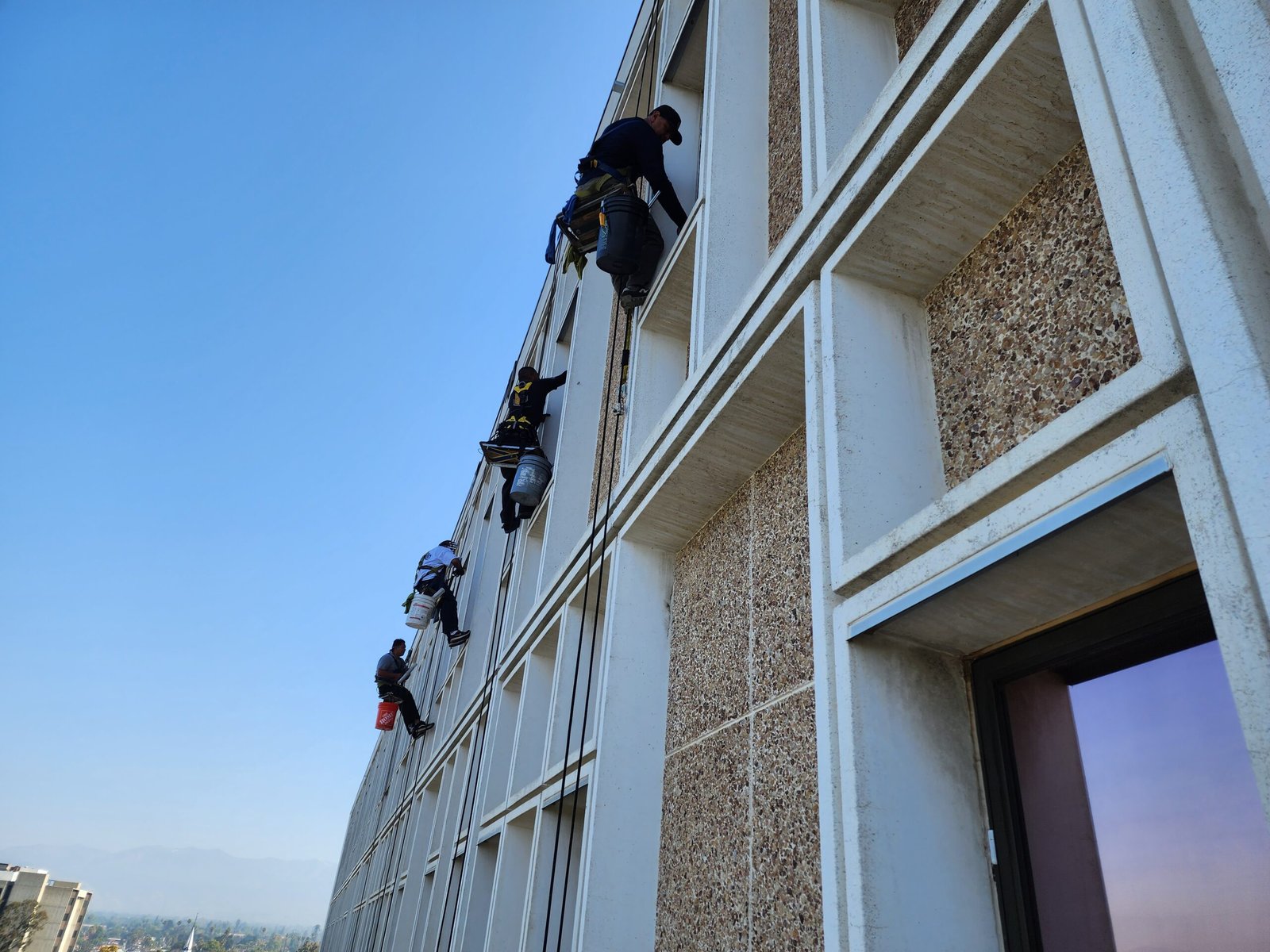
For mid-rise and high-rise commercial buildings in Los Angeles and Long Beach, accessing the full exterior facade for painting is not a simple job. Traditional methods — scaffolding, boom lifts, and swing stages — are expensive, disruptive, time-consuming to set up, and sometimes physically impossible on certain building designs.
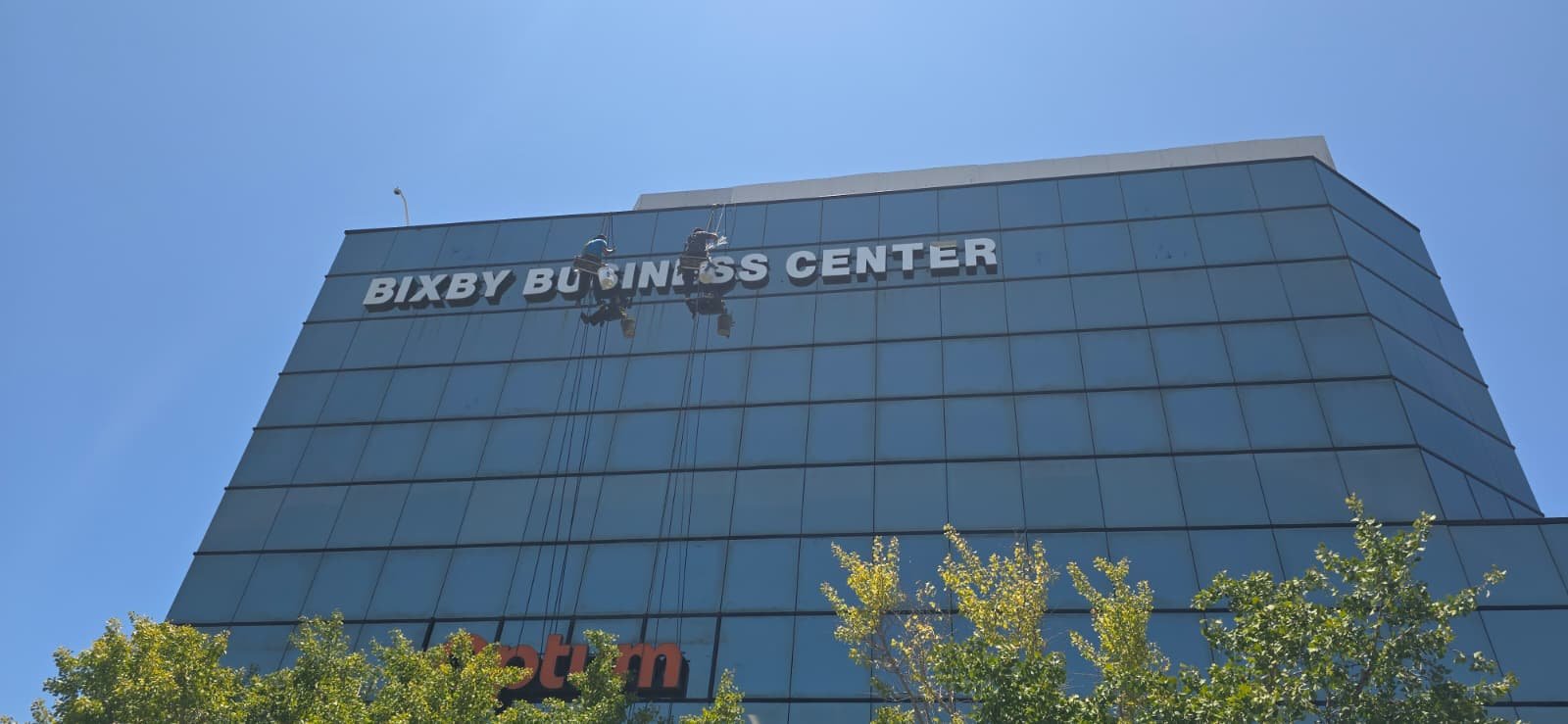
Skyworks Unlimited’s rope access painting service solves this problem entirely. Our IRATA and SPRAT certified technicians are trained to reach every point on a building’s exterior using industrial rope access systems — safely, efficiently, and without the overhead cost and ground-level disruption of scaffolding.
| Factor | Rope Access Painting | Scaffolding |
|---|---|---|
| Setup Time | Hours | Days to Weeks |
| Ground-Level Disruption | Minimal | Significant — parking, footpaths blocked |
| Permit Requirements | Minimal | Extensive in LA, Long Beach, Beverly Hills |
| Cost | Significantly lower | High — equipment + labor + permits |
| Reach | Any point on any facade | Limited by structure and access points |
| Safety Certification Required | IRATA + SPRAT (Skyworks holds both) | Standard scaffold licensing |
| Best For | High-rise and mid-rise commercial buildings | Low-rise structures with ground access |
Learn more: Read our full breakdown of Why Most Cleaning Companies Avoid High-Rise & Rope Access Work — and why Skyworks Unlimited is built specifically for these projects.
05 The Professional Exterior Painting Process — What to Expect
A professional commercial exterior painting project is a structured, multi-stage process. At Skyworks Unlimited, every project follows the same disciplined sequence — regardless of whether it is a three-story office building in Torrance or a 20-story high-rise in Downtown Los Angeles.
Site Assessment and Surface Inspection
Our team performs a detailed inspection of the building’s exterior — identifying failing paint, cracking, moisture damage, substrate delamination, rusting metal components, and failed caulking. This assessment determines the preparation required and the correct paint system specification.
Surface Preparation — Pressure Washing
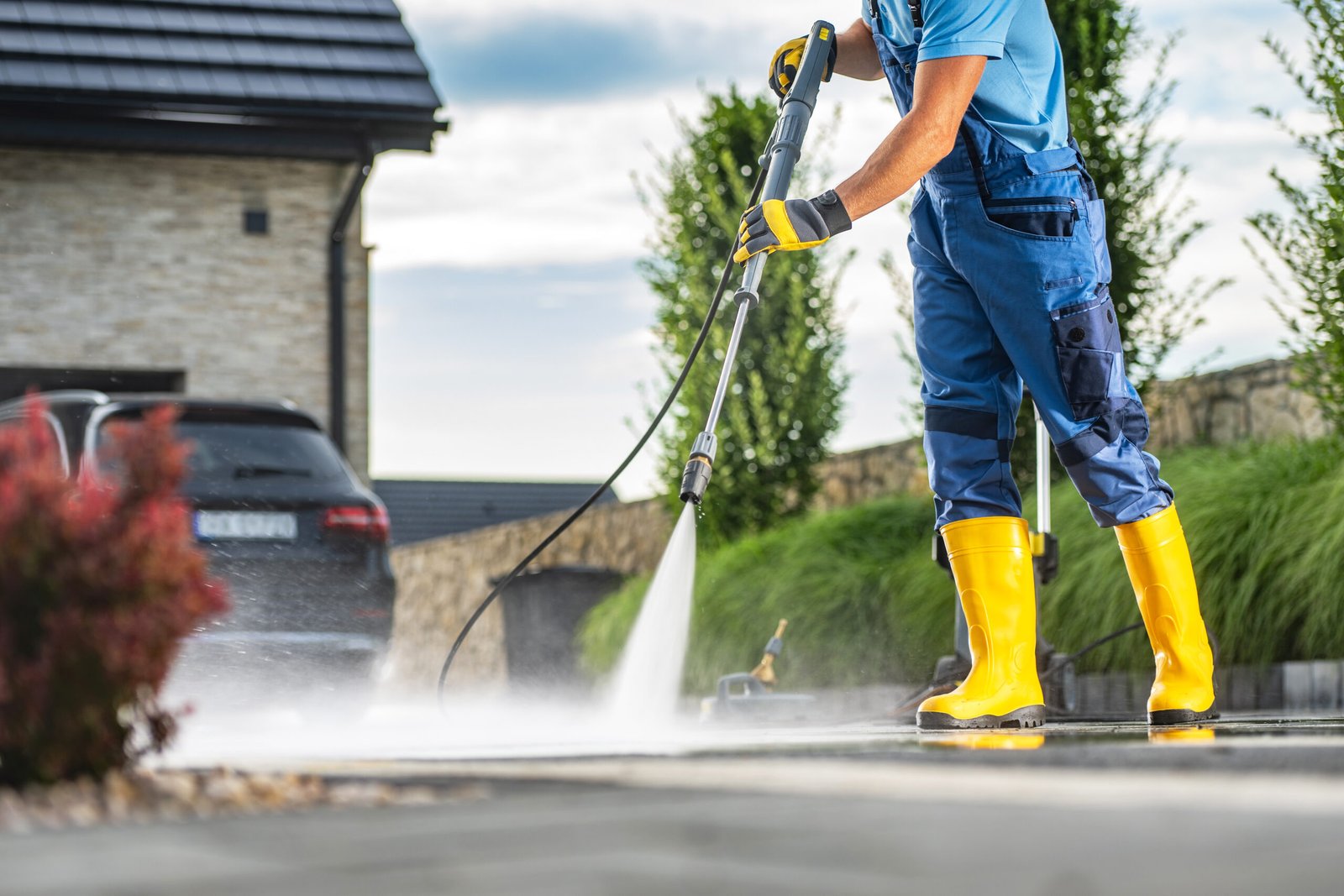
All surfaces are cleaned using professional pressure washing before painting begins. Paint applied over dirt, biological growth, or loose material will fail prematurely. This step is non-negotiable for a paint job that will last its full expected lifespan across Southern California’s environment.
Caulking and Joint Sealing
All window perimeters, expansion joints, penetrations, and surface cracks are re-caulked with appropriate commercial-grade sealants before painting. This step is critical — painting over failing caulk is a leading cause of premature paint system failure and water infiltration.
Priming
Primers are applied to bare or repaired surfaces to ensure adhesion, seal porosity, and provide a chemically compatible base for the topcoat. Metal components receive rust-inhibiting primers. Patched stucco receives penetrating sealers before topcoat application.
Topcoat Application
The specified paint system is applied in the correct number of coats and at the correct mil thickness — following manufacturer specifications to ensure the coating performs as intended and warranty requirements are met. Rope access techniques are used for upper floors and difficult-access areas.
Final Inspection and Touch-Up
A thorough inspection is conducted at completion — verifying coverage, checking for missed areas, and confirming all surfaces have been returned to a clean, professional condition. We do not leave until the job meets our standard — which is the same standard we apply to every property in Los Angeles, Long Beach, and across Southern California.
06 How Often Should Your Commercial Building Be Painted in Southern California?
The right repainting schedule depends on your building’s location, surface material, current paint system, and level of environmental exposure. Here is a general guide for commercial properties across the Los Angeles metro:
Office Buildings, Retail, Mixed-Use in Los Angeles
Well-prepared, high-quality elastomeric or acrylic systems on commercial buildings in Pasadena, Culver City, Hollywood, West Hollywood, and the inland LA Basin typically last 7 to 10 years before recoating is needed. Regular visual inspections help identify early failures before moisture infiltration occurs.
Buildings Near the Ocean in Long Beach, Santa Monica, Venice, Seal Beach
Salt air, marine layer moisture, and intense UV exposure in coastal Southern California accelerates paint degradation significantly. Commercial properties within several miles of the Pacific typically require more frequent repainting cycles — and rust-inhibiting systems on all metal components are non-negotiable.
Ground-Level Retail, Restaurant, Drive-Through, High-Visibility Properties
High-traffic commercial properties in Beverly Hills, Torrance, Hollywood, and along major LA arterials experience more physical contact, exhaust exposure, and graffiti. Annual inspections and spot maintenance — combined with full repainting on a 5 to 7 year cycle — keep these properties looking professional and protected year-round.
Commercial Painting Across Southern California
Skyworks Unlimited provides professional commercial building painting and exterior maintenance throughout the greater Los Angeles metro area and Orange County — using rope access for high-rise and mid-rise buildings.
07 Frequently Asked Questions
Common questions from property managers and building owners across Los Angeles and Southern California about commercial exterior painting.
How often should a commercial building be repainted in Los Angeles? ▾
Does exterior painting really protect a commercial building? ▾
What is rope access painting and why is it used on commercial buildings? ▾
What type of paint is best for commercial building exteriors in Southern California? ▾
Can exterior painting prevent water damage to commercial buildings? ▾
Should exterior painting and window caulking be done at the same time? ▾
Does Skyworks Unlimited offer commercial building painting in Los Angeles? ▾
How much does commercial exterior painting cost in Los Angeles? ▾
Does the building need to be pressure washed before exterior painting? ▾
More from the Skyworks Unlimited Blog
Ready to Protect and Refresh Your Commercial Building?
Skyworks Unlimited provides professional exterior painting, rope access painting, pressure washing, and caulking for commercial buildings across Los Angeles, Long Beach, and all of Southern California. Licensed, insured, and triple-certified.
Get a Free Quote Today Or call us directly: (562) 291-7549Tags & Keywords: