Sign & Banner Installation Using Rope Access: How It Works on High-Rise Buildings in Los Angeles
Every sign company, property manager, and building owner who has ever tried to install, remove, or replace signage on the upper floors of a Los Angeles high-rise has faced the same access problem: scaffolding costs more than the sign itself, boom lifts cannot reach the floor, and the sign has to go up regardless. Certified rope access is the professional answer — and for upper-floor signage on commercial towers across Downtown Los Angeles, Long Beach, Beverly Hills, Santa Monica, and throughout Southern California, it has become the standard method precisely because it solves the access problem without creating a permit problem, a cost problem, or a tenant disruption problem in its place. This complete guide covers exactly how rope access sign and banner installation works on a Los Angeles high-rise — from the first site survey to the final photo confirmation — and what building owners, property managers, and sign companies need to know before their next upper-floor signage project.
Understand the certified standard first: Sign installation and window cleaning use identical rope access certification requirements. Every technician on your building should hold individual SPRAT or IRATA credentials. Read Why SPRAT & IRATA Certification Matters for Your High-Rise Window Cleaning to understand exactly what those credentials require — and what to ask for before any contractor accesses your building.
01 Why Rope Access Is the Standard for High-Rise Sign Installation in Los Angeles
Los Angeles has one of the most competitive commercial real estate and retail leasing markets in the United States — and visible, well-placed building signage is a direct revenue driver for tenants across every market from the Downtown Financial District to West Hollywood‘s Sunset Strip. When a sign must go on the 15th floor of a Bunker Hill office tower or the 8th floor of a Pasadena mixed-use building, the practical question is not whether to install it — it is how to access that floor safely, quickly, and at a cost the project can actually support.
Scaffolding answers the access question structurally but creates a cascade of problems in densely urban Los Angeles markets. A scaffold project on a building in Beverly Hills, Santa Monica, or Downtown LA requires a permit from the Los Angeles Department of Building and Safety, a sidewalk encroachment permit, and potentially a temporary lane closure from the Los Angeles Department of Transportation. Those permits take weeks, and the scaffold erection itself adds days — all before a single bolt of the sign mounting hardware has been installed. For a tenant who signed a lease and needs their sign up by opening day, or for a property manager who has committed to a sign changeover on a lease-end date, those timelines are simply not workable.
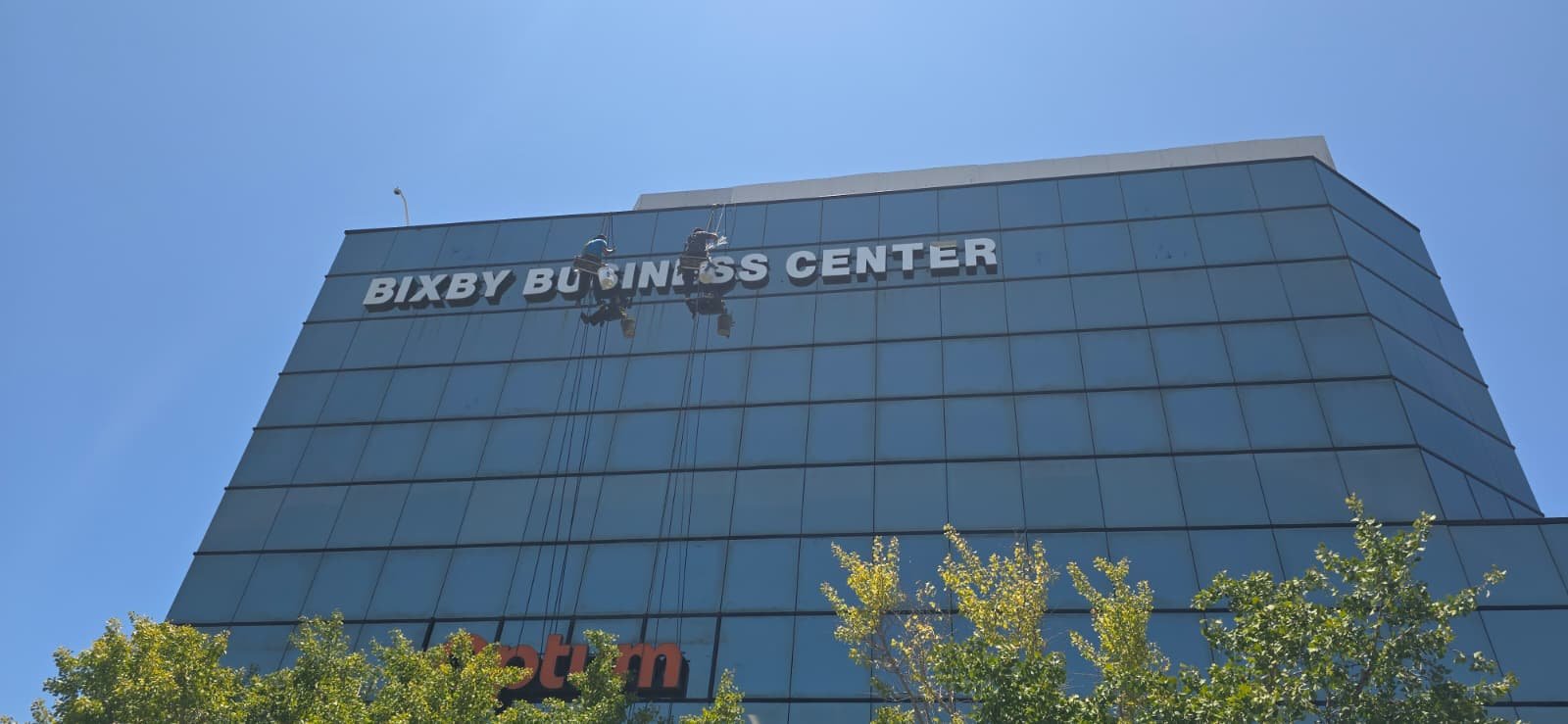
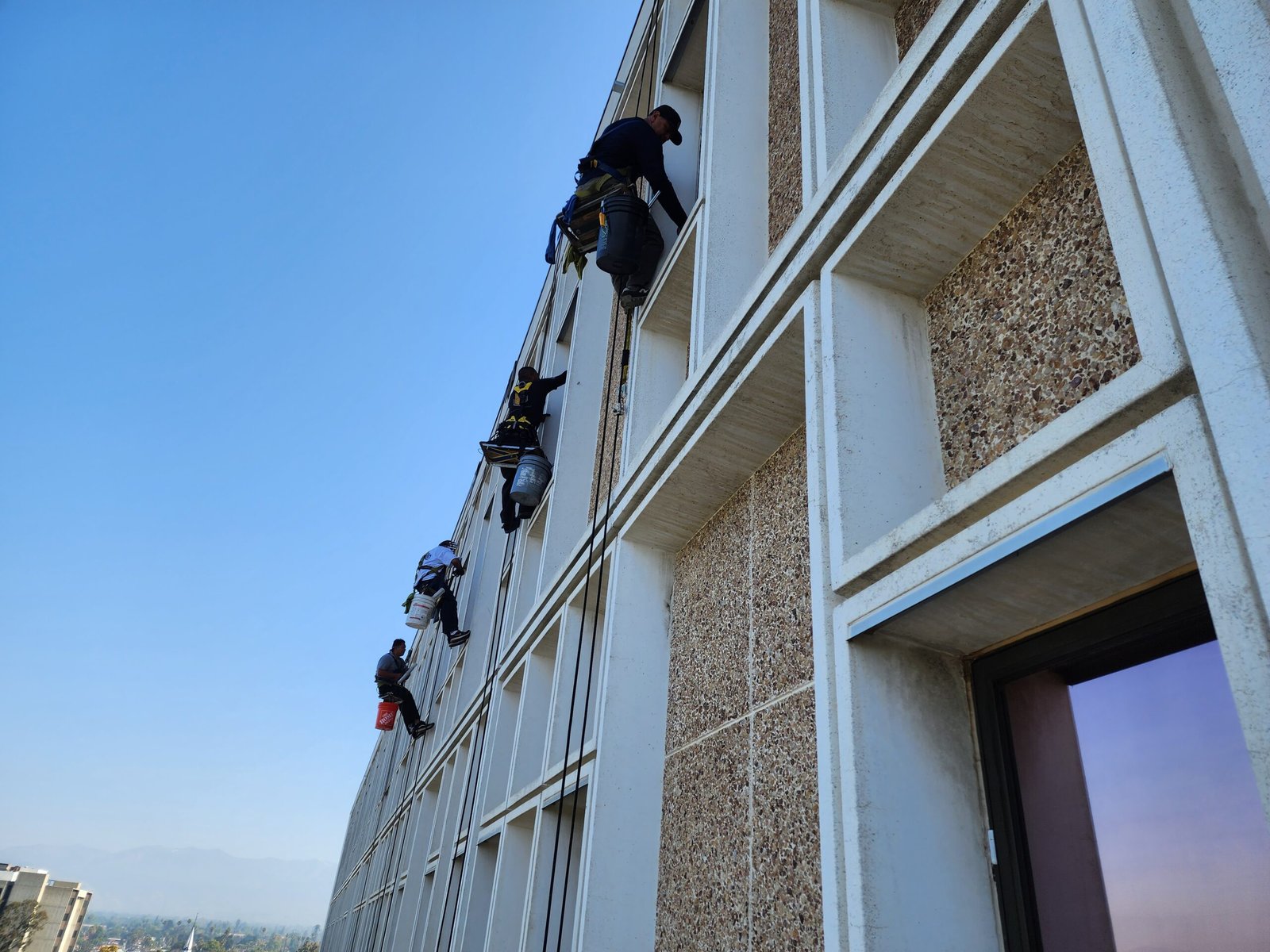
Certified rope access eliminates every one of those delays and most of the associated cost, while delivering a safety record that is statistically better than scaffolding. A certified crew can rig from the roof, descend to the sign position, install mounting hardware, receive sign components via material line, connect and secure the sign, and ascend — all without a permit, without a street closure, and without a scaffold touching the building. The crew arrives on the agreed date, begins work within hours, and the sign is installed the same day on all but the largest installations.
02 What Types of Signs Can Be Installed via Rope Access in Los Angeles
Virtually any sign type that can be safely rigged and lowered to a technician’s working position on a rope can be installed via certified rope access. Here is the full range of signage work Skyworks Unlimited performs on high-rise buildings across Los Angeles and Southern California.
03 The Complete Rope Access Sign Installation Process — Step by Step
Here is exactly how a certified rope access high-rise sign installation project moves from initial assessment to completed, photo-confirmed sign on a Los Angeles building.
Site Survey & Sign Position Assessment
Every rope access sign project in Los Angeles begins with a physical site survey — not a phone call and a Google Street View screenshot. The survey identifies the precise mounting position on the facade, the substrate material at that position (concrete, glass, metal panel, stucco, or composite cladding), anchor point locations on the roof above, required rigging distances, and any physical obstacles between the rope path and the sign position. For illuminated signs, the survey also identifies the nearest electrical infrastructure, conduit routing options, and any city permit requirements for the sign itself under the Los Angeles sign ordinance or the specific jurisdiction’s code — Beverly Hills, Santa Monica, and Pasadena each have distinct sign codes that apply independently of LA city requirements.
Certification, Insurance & Permit Documentation
Before any project date is set, the property owner and sign company receive current SPRAT or IRATA certification records for every rope access technician, a $1 million-plus commercial general liability certificate naming the property as additional insured, and workers’ compensation documentation explicitly covering rope access operations. Sign permit documentation — from the City of Los Angeles, Beverly Hills, Santa Monica, or the relevant jurisdiction — should also be confirmed before mobilization. A certified rope access contractor does not install a sign without confirmed sign permit authorization; an uncertified one often does not ask.
Building Coordination — Roof Access, Materials Staging, & Tenant Notice
Rope access sign installation requires roof access for rigging, freight elevator use for equipment transport, and sometimes building engineer coordination for electrical connection. For occupied commercial buildings in Long Beach, Beverly Hills, and Downtown Los Angeles, tenant notification is typically required when rope access work is scheduled on the building exterior — so tenants on the relevant floors know to expect a technician at window level. This notice is coordinated by the property manager, not assumed to be unnecessary.
Day-Of Hazard Assessment & Anchor Verification
On the morning of every project, a Level 3 SPRAT or IRATA Supervisor completes a written, site-specific hazard assessment covering wind conditions, overhead and electrical hazards at the rigging position, the sign’s planned travel path from the roof to the mounting position, and emergency egress routes. Every roof anchor is inspected and load-verified before any rope is attached. Wind conditions are particularly relevant for sign installation projects — a large vinyl banner or panel sign acts as a sail in the wind, and conditions that are acceptable for window cleaning may require modified rigging for sign handling.
Two-Rope Rigging — Working Line & Safety Line
Each technician descends on an independent working line and a completely separate safety line, rigged to separate, load-verified anchor points and cross-checked before anyone goes over the parapet. For sign installation work, a third material line is rigged separately to lower sign components, mounting hardware, and tools from the roof to the technician’s working position. This material line is managed by a crew member on the roof and is never used as a load-bearing component of the technician’s positioning system — it is a cargo line only.
Mounting Hardware Installation
With the technician positioned at the sign mounting location, mounting hardware — anchor bolts, standoffs, raceways, or direct-mount brackets depending on sign type — is installed into the facade substrate. For concrete and masonry facades common on older Pasadena and Downtown LA buildings, this involves core drilling or hammer-drill anchor installation at rope position. For metal panel systems common on newer commercial towers in Culver City and Signal Hill, substrate-appropriate fasteners and backing plates are used. All mounting hardware is installed, torqued, and confirmed before any sign component is attached.
Sign Component Lowering & Connection
Sign components are lowered from the roof on the material line, controlled by the roof crew to ensure they do not contact the building facade during descent. The technician at the mounting position receives each component, connects it to the installed hardware, and secures all fasteners per the sign manufacturer’s specification. For illuminated channel letters, each letter is installed individually, electrical connections made within the letter, and the letter wired to the raceway or conduit run. For large-format banners, the banner is unrolled at the mounting position and attached to upper and lower banner brackets that were mounted in a prior pass.
Electrical Connection & Illumination Test
For illuminated signs, electrical connections at the building supply point are made per California Electrical Code requirements — either by the rope access team’s licensed electrical coordinator or by a licensed electrician working in concert with the rope access crew. The sign is powered and tested before the crew descends. A sign that cannot be fully tested before the crew leaves the position requires a return trip that rope access scheduling can usually avoid with a complete pre-departure illumination check at the sign position itself.
Ground Exclusion Zone Management
A clearly marked, actively supervised exclusion zone is maintained on the ground directly below the work area for the entire project duration. On public sidewalks in Beverly Hills, Hollywood, and Santa Monica where foot traffic is constant, this zone prevents any pedestrian from entering the area below a sign component or tool that could be dropped during installation. This is a non-negotiable safety requirement — not a discretionary precaution that can be skipped on short projects or “quick” sign swaps.
Photo Documentation & Completion Report
Every rope access sign installation project closes with photo documentation of the completed sign from both the technician’s position at the facade and the ground-level view. A written completion report is delivered to the property manager and sign company noting mounting method, hardware used, any substrate conditions identified during installation, electrical connections made, and test results. This report is the project record for both building maintenance files and the sign company’s installation warranty documentation.
Related reading: The rigging, anchor verification, and hazard assessment steps above are identical to those used in certified high-rise window cleaning. Read our Downtown LA high-rise window cleaning process guide for the full documented eight-step process — the same safety framework that governs every rope access project Skyworks Unlimited runs, including sign and banner installation.
04 Rope Access vs. Scaffolding vs. Boom Lift for High-Rise Sign Installation
Here is the direct comparison across every dimension that matters for sign installation on a Los Angeles high-rise — the comparison every sign company, property manager, and building owner should make before the access method is locked in:
| Dimension | Certified Rope Access | Scaffolding | Boom Lift |
|---|---|---|---|
| Maximum height reached | Unlimited — any floor a verified anchor above can serve | Unlimited — with engineering | ~10 stories maximum; ground clearance required |
| Mobilization speed in LA | Days — rigging from roof in hours | 3–6 weeks — LADBS permit, procurement, erection | 1–3 days — equipment hire and transport |
| Street / sidewalk permits in LA, Beverly Hills, Santa Monica | None — exclusion zone only | LADBS, sidewalk encroachment, possible lane closure | Street access permit required in dense corridors |
| Total access cost vs. rope access | Baseline — lowest total cost | Often 3–5× the rope access cost on high floors | Lower than scaffold, higher than rope access; not viable above 10 stories |
| Tenant disruption | Minimal — no scaffold blocking views or lobbies | Weeks of view blockage, lobby equipment, erection noise | Vehicle presence, noise, parking use |
| Safety incident rate | Lowest — two-rope redundancy, Level 3 Supervisor | Higher — assembly variables, extended site presence | Moderate — tip-over and outreach risk |
| Sign component handling at height | Excellent — dedicated material line, controlled lowering | Good — stable platform for large components | Limited — platform size restricts component size at height |
05 Sign Removal & Replacement via Rope Access in Los Angeles
Rope access is used as often for sign removal as for installation on Los Angeles high-rise buildings — and the removal process has its own considerations that property managers and sign companies need to understand before scheduling a project.
Tenant Changeover Sign Removal
Lease-end sign removal is one of the most time-sensitive rope access sign projects in the Los Angeles commercial real estate market. A former tenant’s sign must come down on a specific date — often driven by the incoming tenant’s lease commencement — and scaffolding’s three-to-six-week lead time makes it an unworkable solution for most changeover schedules. Rope access teams in Long Beach, Beverly Hills, West Hollywood, and Downtown LA can mobilize for sign removal within days of booking — and handle facade repair at the anchor points in the same visit.
Facade Repair After Sign Removal
When a sign is removed from a building facade, the mounting points — anchor bolt holes, raceway profiles, conduit stubs — must be addressed to restore the facade’s appearance and weatherproofing. A rope access team that handles both the sign removal and the subsequent patch, fill, and paint work completes the project in fewer total mobilizations than contracting those steps separately. For high-rise buildings in Pasadena, Signal Hill, and Torrance, this single-contractor efficiency is both a cost saving and a scheduling advantage.
Damaged or Failed Sign Replacement
Illuminated signs on upper building floors fail for several reasons — UV exposure degrades face materials, electrical components reach end of life, impact from wind-driven debris damages sections, or individual channel letters develop lighting failures. Rope access teams can reach and replace a single failed channel letter, replace a blown transformer on a roof-mounted section, or swap an entire sign cabinet without the full scaffold mobilization that the same task would require using traditional access. For sign companies managing service contracts on commercial properties across Culver City, Venice, and Lakewood, rope access service capability dramatically improves the economics of high-floor sign maintenance contracts.
Temporary Banner Removal After Event Period
Vinyl banners and event graphics installed for a specific campaign or opening period must be removed on a schedule that is typically not negotiable — permit expiry, lease conditions, or building management policy sets the removal date, and that date does not accommodate a scaffold permitting timeline. Rope access teams remove temporary banners at upper floor positions on the scheduled date, clean and inspect the mounting hardware for reuse, and clear the facade the same day — giving property managers in Hollywood, Santa Monica, and Bixby Knolls the deadline compliance their building rules require.
06 High-Rise Sign Installation Across Los Angeles Markets — What Makes Each City Different
Sign installation on high-rise buildings in Los Angeles is not governed by a single rulebook. Each city within the greater LA market has its own sign ordinance, its own permit process, and its own enforcement culture — and a rope access sign installation company serving this region needs to know the difference between them. Here is the local context that matters for the markets Skyworks Unlimited serves.
07 What Skyworks Unlimited Delivers on Every Sign Installation Project
Every standard described in this guide is exactly how Skyworks Unlimited runs sign and banner installation projects on high-rise buildings across Los Angeles and Southern California.
SPRAT & IRATA Certified — Individual Certificates Before Every Mobilization
Every Skyworks Unlimited rope access technician holds current SPRAT or IRATA certification at documented levels. Individual certificates are available to the property manager, sign company, and building owner before any project mobilizes — not produced on request the morning of the job. A Level 3 Supervisor is present on-site from first rigging to final pack-down on every sign installation project across Downtown LA, Long Beach, Beverly Hills, and every other market we serve.
$1M+ General Liability — Property as Additional Insured on Every Project
Every Skyworks Unlimited sign installation project is backed by $1 million or more in commercial general liability coverage with the property named as additional insured — standard, not available only on request. Workers’ compensation explicitly covers rope access operations. These documents are provided before project start, not after a damage claim makes them relevant.
Physical Site Survey Before Every Quote — No Remote Estimating for High-Rise Work
Skyworks Unlimited conducts a physical site survey before providing any quote for high-rise sign installation — assessing anchor infrastructure, facade substrate, rigging path, sign component weight and dimensions, and wind exposure at the installation elevation. Our quotes reflect the actual project on the actual building, not a generic per-floor rate.
Photo-Documented Completion Report — Sign Company & Property Manager Copies
Every Skyworks Unlimited sign installation project closes with a photo-documented completion report showing pre-installation conditions, installation in progress, completed sign from the facade position, and completed sign from the ground. Copies go to both the property manager and the sign company — providing installation documentation for warranty records, permit close-out, and building maintenance files. Our facade inspection services can be integrated into the same mobilization to assess facade condition at the sign mounting location and the surrounding elevation during the same rope access visit.
Know what to ask before you hire: The certification and insurance questions that apply to window cleaning apply identically to rope access sign installation. Read our complete Questions to Ask Before Hiring a Window Cleaning Service — every question and red flag listed applies to any at-height rope access contractor you evaluate for sign work in Los Angeles.
08 What to Look for When a Rope Access Crew Installs Your Sign in Los Angeles
Whether you are a property manager watching from the lobby, a sign company rep on-site for the installation, or a building owner reviewing photos after the fact, here is what a properly managed rope access sign installation looks like from the ground.
Rope Access Sign & Banner Installation — Los Angeles & Southern California
Skyworks Unlimited provides certified SPRAT and IRATA rope access sign installation, banner hanging, sign removal, and facade sign services for commercial, residential, and mixed-use high-rise buildings throughout Los Angeles and Southern California.
Frequently Asked Questions
Common questions from Los Angeles sign companies, property managers, and building owners about high-rise sign and banner installation using rope access.
How does rope access work for sign installation on a high-rise building in Los Angeles? ▾
What types of signs can be installed using rope access in Los Angeles? ▾
Is rope access sign installation cheaper than scaffolding for high-rise buildings in Los Angeles? ▾
What certifications do rope access sign installers need in Los Angeles? ▾
Can rope access teams remove and replace existing signs on high-rise buildings in Los Angeles? ▾
Does Skyworks Unlimited provide rope access sign installation in Los Angeles? ▾
More from the Skyworks Unlimited Blog
Need Sign or Banner Installation on a Los Angeles High-Rise?
Skyworks Unlimited provides certified SPRAT & IRATA rope access sign and banner installation, removal, and replacement on high-rise buildings across Downtown LA, Long Beach, Beverly Hills, Santa Monica, Hollywood, Signal Hill, Pasadena, and throughout Southern California. Free site survey. Fully insured. Photo-documented completion report on every project.
Request a Free Quote Or speak directly with our team: (562) 291-7549Tags & Keywords:
#RopeAccessSignInstallation #HighRiseSignInstallation #BannerInstallationLA #SignInstallationLosAngeles #RopeAccessLA #CertifiedRopeAccess #SPRATCertified #IRATACertified #SkyworksUnlimited #CommercialSignage #HighRiseBannerLA #SignRemovalLA #BuildingSignsLA #LosAngelesSignInstallation #LongBeachSignInstallation #BeverlyHillsSignInstallation #RopeAccessSignage